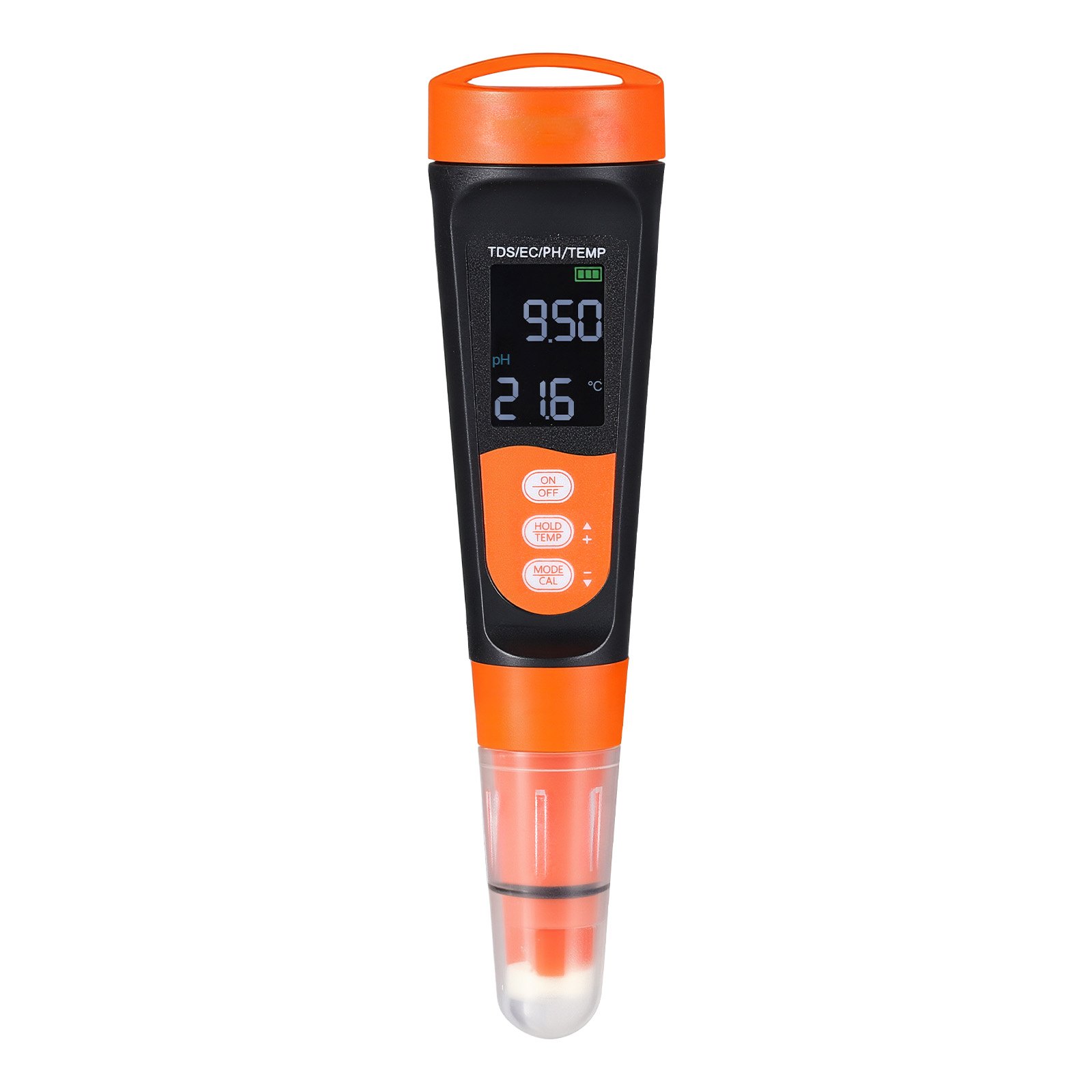

Photos from current listings. Actual item, color, and included accessories may vary.
Ec Meter Buying Guide
An EC meter measures electrical conductivity to quantify dissolved nutrient salts in water, and the core trade-off is between a sealed waterproof probe with replaceable electrodes versus a non-replaceable budget pen. Choose a meter with a detachable or replaceable probe, automatic temperature compensation (ATC), and ±2% full-scale accuracy for hydroponics; skip sealed pens with no calibration or probe replacement path for anything beyond casual spot checks.
Key takeaways
- ATC is non-negotiable for hydroponics: conductivity drifts roughly 2% per °C, so meters without temperature compensation misreport nutrient strength across seasons.
- Probe construction determines lifespan: platinum-black or graphite electrodes resist fouling and can be cleaned, while exposed copper or bare-metal sensors corrode in nutrient solution within weeks.
- Waterproof ratings split real field use: IP67/IP68 pens survive reservoir drops, while IP54 or unrated bodies allow moisture ingress at the battery cap and display seam.
At a glance
- Category
- Spectroscopy, Analysis & Detection Instruments
- Last updated
- Nov 28, 2026
Current offers
Highlights
- ATC is non-negotiable for hydroponics: conductivity drifts roughly 2% per °C, so meters without temperature compensation misreport nutrient strength across seasons.
- Probe construction determines lifespan: platinum-black or graphite electrodes resist fouling and can be cleaned, while exposed copper or bare-metal sensors corrode in nutrient solution within weeks.
- Waterproof ratings split real field use: IP67/IP68 pens survive reservoir drops, while IP54 or unrated bodies allow moisture ingress at the battery cap and display seam.
- Multi-parameter pens add EC, TDS, pH, and sometimes salinity/orp on one board; TDS is derived from EC via a fixed conversion factor (commonly 0.5 or 0.7), so check which scale the display uses.
Best use cases
- Hydroponic reservoirs and recirculating systems: pick a waterproof pen with ATC, replaceable probe, and calibration solutions in 1.413 mS/cm and 12.88 mS/cm ranges — skip single-point sealed pens.
- Soil and coco runoff testing: choose a meter that reads EC in mS/cm and µS/cm with a narrow-tip probe that fits runoff cups; skip wide-body lab meters that cannot enter sample cups.
- Casual pool, aquarium, and tap-water spot checks: a basic IP67 pen with ±2% accuracy and two-point calibration is sufficient; skip multi-parameter pH/EC combo units unless pH accuracy is also required.
- Commercial or high-frequency dosing control: select a benchtop or inline conductivity controller with 0.01 resolution and continuous logging; pocket pens are wrong-fit for automated fertigation.
Buying tips
- Match range to application: hydroponics nutrients typically run 0.5–3.0 mS/cm (500–3000 µS/cm), so a 0–20 mS/cm pen covers all common reservoirs with headroom.
- Verify calibration standard values before buying: a meter must ship with or support 1.413 mS/cm and 12.88 mS/cm solutions; single-point calibration at 1.413 alone is insufficient above 5 mS/cm.
- Check probe replaceability: if the electrode is molded into the body, the entire pen becomes e-waste at the first scratch or fouling — replaceable probes extend service life.
- Confirm display units and conversion: EC in mS/cm vs µS/cm and TDS via 0.5 or 0.7 factor; a 1000 µS/cm reading equals 1.0 mS/cm, and TDS scales differ by up to 40% between factors.
Specs
| Measurement Range | 0–20 mS/cm (0–20,000 µS/cm) |
|---|---|
| Accuracy | ±1–2% full scale |
| Temperature Comp. | ATC, 0–50 °C typical |
| Probe & Rating | Replaceable / IP67–IP68 pen |
Related searches
What to check before buying
- Reservoir or sample container depth and opening diameter: pen probes need at least 3–5 cm of immersion and a body narrow enough to enter the vessel.
- Temperature range of your solution: confirm ATC coverage spans your water temperature (typically 0–50 °C) to avoid out-of-range errors in cold or heated reservoirs.
- Calibration supplies and storage: budget for calibration sachets and electrode storage solution — dry-stored probes drift faster and fail sooner.
- Battery type and replacement: button-cell (LR44/CR2032) versus AAA affects cost and field replaceability; confirm the battery door seals against moisture.
FAQ
Data sources: eBay / Amazon listings and product attribute feeds. Updated Nov 28, 2026.
Some links on this page are affiliate links. If you buy after clicking one, we may earn a commission at no extra cost to you. This does not change which products appear here or their order. Affiliate disclosure.