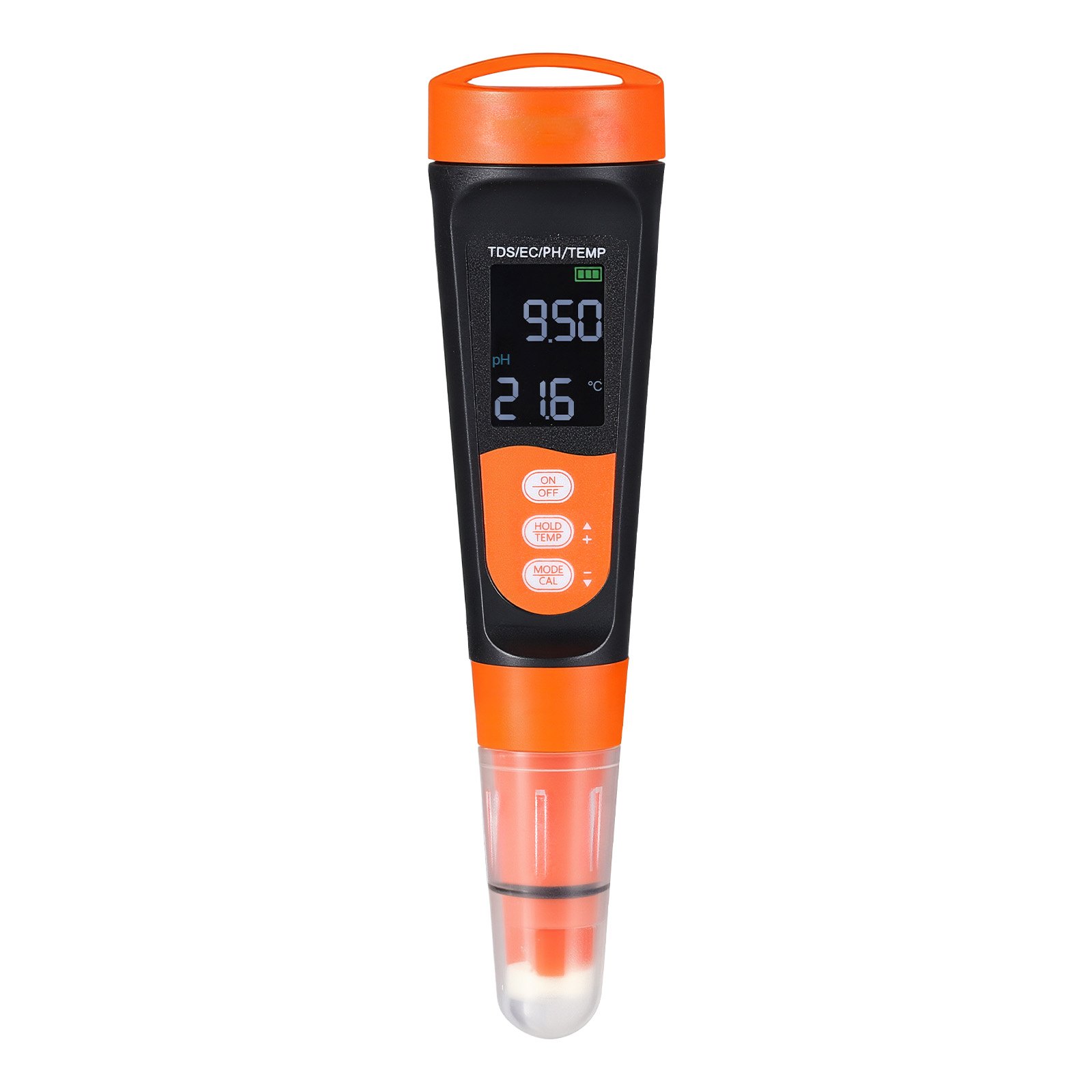

Photos from current listings. Actual item, color, and included accessories may vary.
Ph And Tds Meter Buying Guide
A pH and TDS meter is a dual-purpose water-quality instrument that pairs a glass-bulb pH electrode with a conductivity cell to read acidity/alkalinity and total dissolved solids in one handheld unit. The core trade-off is electrode quality and calibration method versus price: lab-grade replaceable probes with multi-point buffers hold accuracy for years, while sealed economy pens drift and need frequent re-calibration. The clear decision rule: buy a meter with a replaceable probe, at least two-point pH calibration, and separate EC/TDS conversion—skip sealed units that cannot be recalibrated with standard buffer powders.
Key takeaways
- pH accuracy tiers: ±0.01 pH (lab/field grade, ATC, replaceable electrode) vs ±0.1 pH (economy pen, sealed bulb, no temperature compensation)
- TDS/EC resolution tracks conductivity cell constant: 0.1–1.0 EC cells resolve 1 ppm; cheap pens often round to 10 ppm and misstate the TDS conversion factor
- IP-rated probes (IP67/IP68) allow full submersion for field and hydroponic use; non-rated pens must stop at the housing seam
At a glance
- Category
- Spectroscopy, Analysis & Detection Instruments
- Last updated
- Nov 28, 2026
Current offers
Highlights
- pH accuracy tiers: ±0.01 pH (lab/field grade, ATC, replaceable electrode) vs ±0.1 pH (economy pen, sealed bulb, no temperature compensation)
- TDS/EC resolution tracks conductivity cell constant: 0.1–1.0 EC cells resolve 1 ppm; cheap pens often round to 10 ppm and misstate the TDS conversion factor
- IP-rated probes (IP67/IP68) allow full submersion for field and hydroponic use; non-rated pens must stop at the housing seam
- Calibration workflow separates true instruments from toys: two- or three-point pH (4.01/7.00/10.01) plus 1413 µS/cm EC standard, versus single-point push-button calibration
Best use cases
- Hydroponics and aquaponics: pick a combo pen with 0.1 EC resolution, ATC, and replaceable probe—skip sealed single-point TDS-only pens that cannot track nutrient swings.
- Drinking-water and RO checks: a 1 ppm TDS resolution pen plus ±0.1 pH is sufficient; skip lab-grade meters with 0.01 pH accuracy you cannot maintain without fresh buffers.
- Pool and spa: choose a meter with pH 6.0–8.5 range and TDS to 5000 ppm; skip narrow-range aquarium pens that top out at 1999 ppm.
- Lab or regulatory sampling: select a benchtop or field meter with 0.01 pH, three-point calibration, and a replaceable glass electrode; skip pocket combo pens lacking documented accuracy specs.
Buying tips
- Match pH accuracy to your tolerance: ±0.01 for nutrient dosing and lab work, ±0.1 for general water checks—you pay for electrode quality and temperature compensation.
- Require automatic temperature compensation (ATC) covering 0–50 °C; without it a 10 °C offset can shift pH readings by 0.1–0.2 units.
- Confirm TDS uses the 0.5 conversion factor (EC × 500) and states ppm resolution of 1; pens that only show 10 ppm steps hide nutrient drift.
- Insist on a replaceable probe or electrode module: a sealed pen becomes landfill once the bulb fouls, while replaceable heads extend life for years.
Specs
| pH Accuracy | ±0.01 lab vs ±0.1 economy |
|---|---|
| TDS Resolution | 1 ppm (0.1 EC) vs 10 ppm |
| Calibration Points | 2–3 point buffer vs 1-point |
| Probe Rating | IP67/IP68 replaceable vs sealed |
Related searches
What to check before buying
- Confirm your sample container depth versus probe length: most pocket pens need at least 3–4 cm of water to submerge the bulb and conductivity cell.
- Check whether the kit includes pH 4.01/7.00 buffer powders and 1413 µS/cm EC standard—calibration consumables are not optional for accuracy claims.
- Verify display and housing are rated for your environment: IP67/IP68 for wet field or hydroponic use, splash-resistant only for benchtop.
- Match power and storage: button-cell pens need spare batteries and wet storage caps; rechargeable units need USB-C and keep the bulb hydrated.
FAQ
Data sources: eBay / Amazon listings and product attribute feeds. Updated Nov 28, 2026.
Some links on this page are affiliate links. If you buy after clicking one, we may earn a commission at no extra cost to you. This does not change which products appear here or their order. Affiliate disclosure.