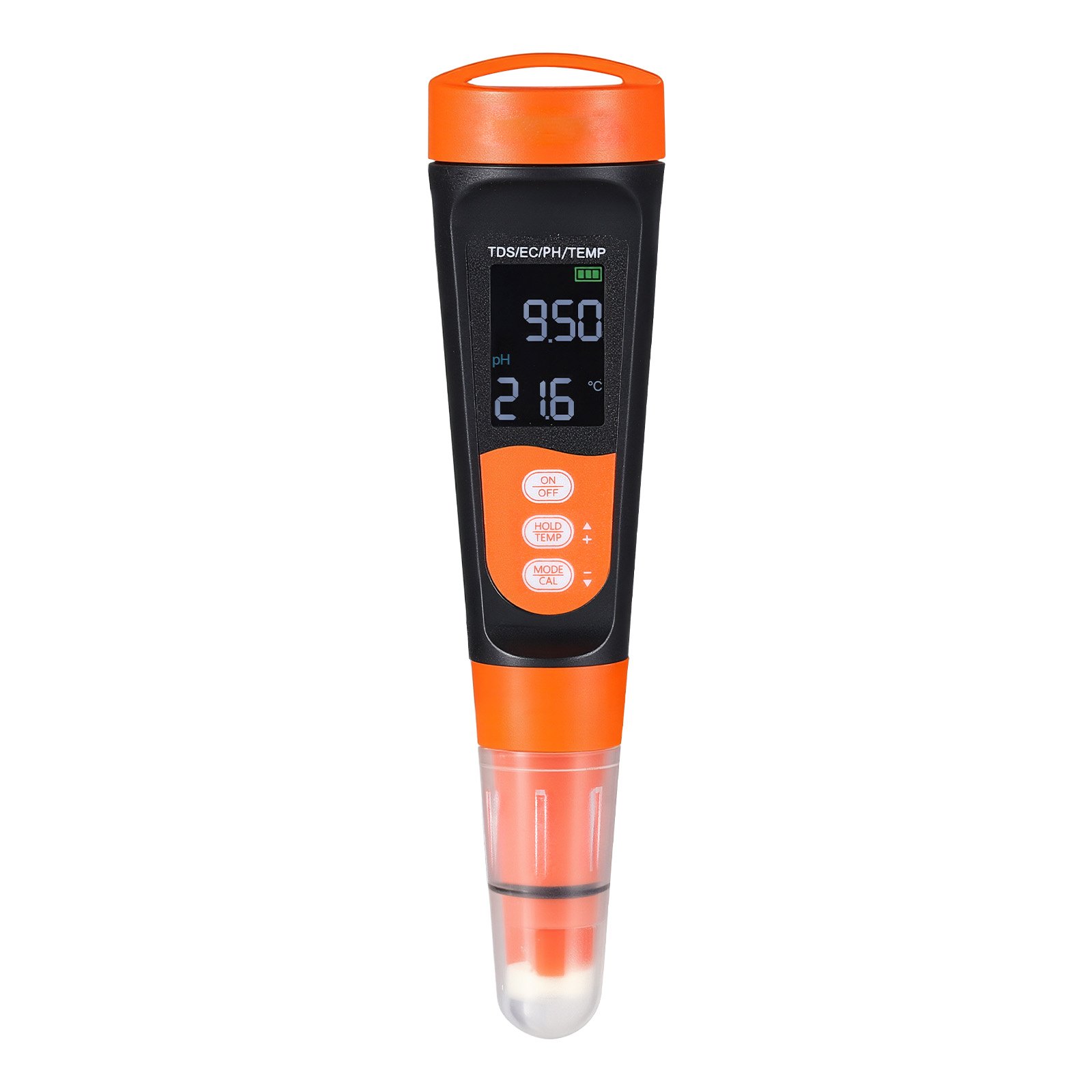

Photos from current listings. Actual item, color, and included accessories may vary.
Ph Ec Tester Buying Guide
A pH/EC tester is a handheld or pen-style instrument combining a glass-bulb or ISFET pH electrode with a conductivity cell to measure acidity and nutrient strength in water. The core trade-off is electrode quality and calibration stability: lab-grade replaceable probes hold calibration for weeks, while sealed budget pens drift within days and cannot be repaired. Buy a tester with a replaceable probe, at least two-point pH calibration, and temperature compensation if you need readings you can trust across seasons.
Key takeaways
- pH sensing uses either a glass bulb (fast, accurate, fragile) or ISFET solid-state sensor (durable, slower stabilization, no storage solution needed).
- EC/TDS accuracy depends on a 2-electrode cell with automatic temperature compensation; without ATC, readings shift roughly 2% per °C.
- IP68 waterproof probes allow full submersion for rinsing, but only the probe end is typically rated — the display housing is usually IP65 or less.
At a glance
- Category
- Spectroscopy, Analysis & Detection Instruments
- Last updated
- Nov 28, 2026
Current offers
Highlights
- pH sensing uses either a glass bulb (fast, accurate, fragile) or ISFET solid-state sensor (durable, slower stabilization, no storage solution needed).
- EC/TDS accuracy depends on a 2-electrode cell with automatic temperature compensation; without ATC, readings shift roughly 2% per °C.
- IP68 waterproof probes allow full submersion for rinsing, but only the probe end is typically rated — the display housing is usually IP65 or less.
- Resolution tiers separate pens: 0.01 pH / 1 µS/cm resolution for hydroponics versus 0.1 pH / 10 µS/cm for casual pool or aquarium checks.
Best use cases
- Hydroponics and coco coir: pick a combo pen with 0.01 pH resolution, EC range to at least 5 mS/cm, and ATC — skip single-function pH pens that force two separate dips.
- Aquarium and shrimp tanks: choose a low-range EC pen (0–2000 µS/cm) with 1 µS/cm resolution; a broad 0–20 mS/cm hydroponics pen loses precision at tank-strength readings.
- Pool and spa: a 0.1 pH resolution pen with replaceable electrode is sufficient; skip multi-parameter combo units whose EC cell is irrelevant to sanitizer chemistry.
- Field/soil slurries: use a waterproof probe with a detachable cable; skip all-in-one pen designs where the display must be held near wet soil.
Buying tips
- Confirm the pH electrode is replaceable or user-calibratable with standard 4.01/7.00 buffer — sealed non-replaceable pens become e-waste after 12–18 months of drift.
- Match EC range to application: 0–2000 µS/cm for aquariums, 0–20 mS/cm for hydroponics; a single wide-range pen sacrifices resolution at the low end.
- Check calibration buffer packets included: two-point (4.01 + 7.00) covers most uses; three-point adds 10.01 for alkaline solutions above pH 9.
- Prefer pens with automatic temperature compensation stated as 0–50 °C; manual temperature entry invites error whenever water temperature changes.
Specs
| pH Sensor Type | Glass bulb vs ISFET solid-state |
|---|---|
| EC Range | 0-2000 µS/cm vs 0-20 mS/cm |
| pH Resolution | 0.01 pH vs 0.1 pH |
| Temp Compensation | ATC 0-50 °C vs manual entry |
Related searches
What to check before buying
- Measure your typical sample volume: a pen needs at least 2–3 cm of submersion depth; shallow trays require a probe on a cable.
- Verify your water temperature range stays within the tester's ATC window (commonly 0–50 °C); hot nutrient mixes above 50 °C will damage glass bulbs.
- Confirm you have storage solution ( KCl ) for glass-bulb pH electrodes — dry storage shortens probe life to months.
- Check whether calibration powders are included and their expiry; expired buffer powder gives false calibration and bad readings.
FAQ
Data sources: eBay / Amazon listings and product attribute feeds. Updated Nov 28, 2026.
Some links on this page are affiliate links. If you buy after clicking one, we may earn a commission at no extra cost to you. This does not change which products appear here or their order. Affiliate disclosure.