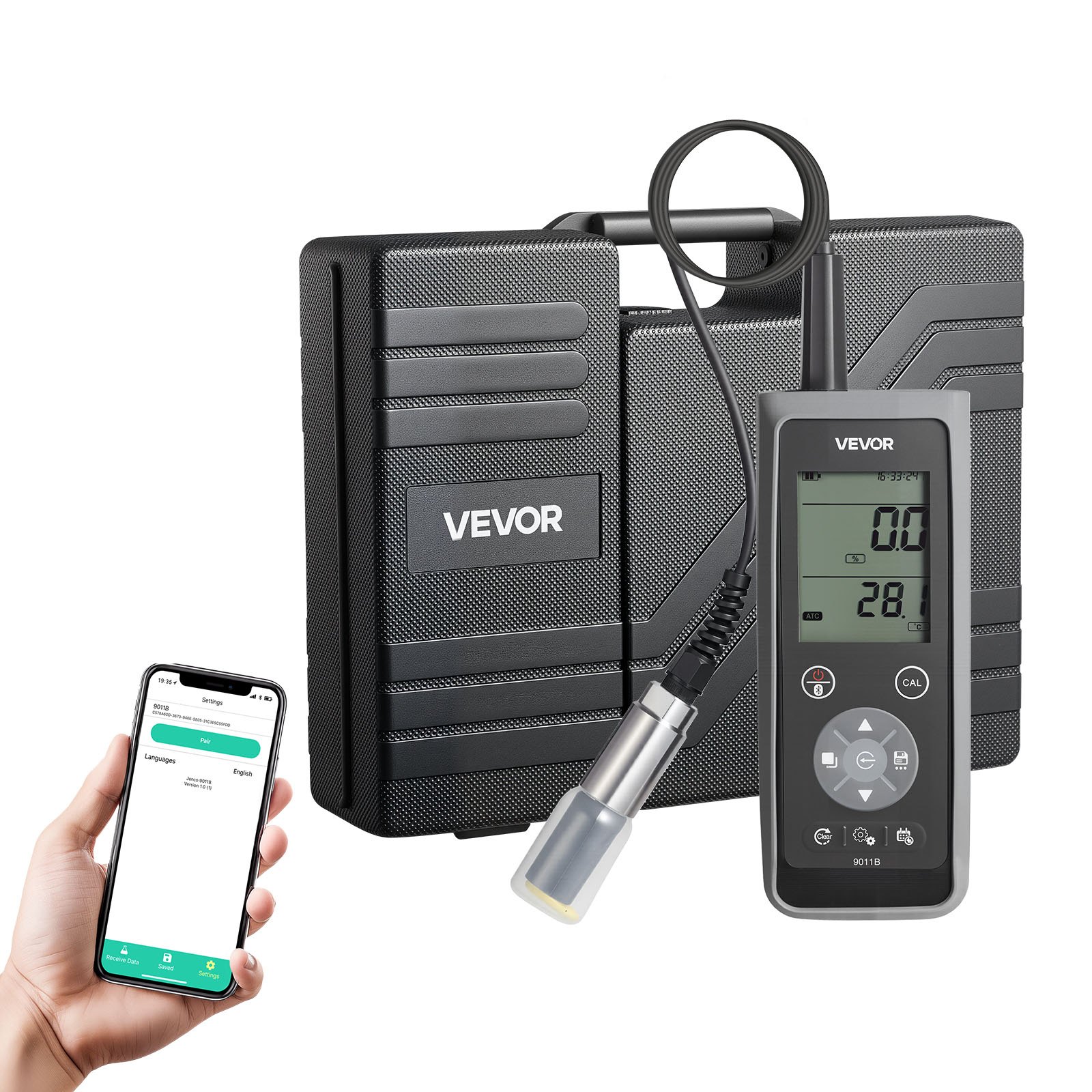

Photos from current listings. Actual item, color, and included accessories may vary.
Portable Dissolved Oxygen Meter Buying Guide
A portable dissolved oxygen meter measures DO in mg/L or % saturation for ponds, aquaculture, wastewater, and field water testing. The decisive trade-off is sensor architecture: optical (luminescent) sensors last years with minimal maintenance, while galvanic/polarographic sensors are cheaper but need membrane and electrolyte service. Buy optical for long-term low-maintenance accuracy; buy galvanic only for tight-budget spot checks with routine upkeep.
Key takeaways
- Optical luminescent sensors use a replaceable cap (typically 1-3 year life) and need no electrolyte refills; galvanic cells need membrane and electrolyte changes every few weeks.
- Galvanic/polarographic probes require flowing water past the membrane (stirring) for accurate readings; optical sensors read reliably in still water.
- DO accuracy is typically ±0.2-0.5 mg/L for quality meters; 0.0-50.0 mg/L range with 0.1 mg/L resolution suits pond and wastewater levels.
At a glance
- Category
- Spectroscopy, Analysis & Detection Instruments
- Last updated
- Nov 28, 2026
Current offers
Highlights
- Optical luminescent sensors use a replaceable cap (typically 1-3 year life) and need no electrolyte refills; galvanic cells need membrane and electrolyte changes every few weeks.
- Galvanic/polarographic probes require flowing water past the membrane (stirring) for accurate readings; optical sensors read reliably in still water.
- DO accuracy is typically ±0.2-0.5 mg/L for quality meters; 0.0-50.0 mg/L range with 0.1 mg/L resolution suits pond and wastewater levels.
- Cable length drives field usability: 3-5 m (10-16 ft) cables reach pond banks and tanks; Bluetooth/USB logging tiers add trend capture but not better sensor accuracy.
Best use cases
- Best fit: optical DO meter for weekly pond/aquaculture monitoring — no electrolyte upkeep, stable in still water, cap replacement once a year or less.
- Wrong fit: a cheap galvanic pen for daily compliance testing — membrane fouling and stirring dependence cause drift; step up to optical for repeated measurements.
- Best fit: galvanic meter with 3-5 m cable for occasional spot checks in tanks and streams where budget matters more than maintenance-free operation.
- Skip: meters with fixed short probes under 1 m if you test from pond banks or deep tanks — cable length of 3-5 m (10-16 ft) is the practical minimum.
Buying tips
- Choose optical (luminescent) sensors when you measure more than twice a month: cap life of 1-3 years beats frequent membrane/electrolyte service.
- Match range and resolution to your water: 0-20 mg/L and 0.1 mg/L resolution covers ponds and aquaculture; 0-50 mg/L suits wastewater and high-load systems.
- Require automatic temperature compensation (ATC) and a separate temperature readout — DO solubility changes with temperature and salinity, so uncompensated meters mislead.
- For field use, pick 3-5 m (10-16 ft) shielded cables and IP67 or better housing; short fixed probes force unsafe bank-edge sampling.
Specs
| Sensor Type | Optical luminescent vs galvanic |
|---|---|
| DO Range | 0-20 mg/L ponds; 0-50 mg/L wastewater |
| Probe Cable | 3-5 m (10-16 ft) typical |
| Maintenance | Optical cap 1-3 yr; galvanic kits |
Related searches
What to check before buying
- Measure your sampling distance and depth: probe cable of 3-5 m (10-16 ft) is needed for pond banks, tanks, and deep profiles.
- Confirm salinity range you test — DO varies with salinity; meters with salinity compensation settings are needed for brackish or seawater.
- Check calibration access: optical meters calibrate in water-saturated air or zero solution; galvanic meters need zero-oxygen solution and membrane kits on hand.
- Verify power and spares: standard AA/AAA or rechargeable batteries, plus replacement caps (optical) or membranes/electrolyte (galvanic) available for your model.
FAQ
Data sources: eBay / Amazon listings and product attribute feeds. Updated Nov 28, 2026.
Some links on this page are affiliate links. If you buy after clicking one, we may earn a commission at no extra cost to you. This does not change which products appear here or their order. Affiliate disclosure.