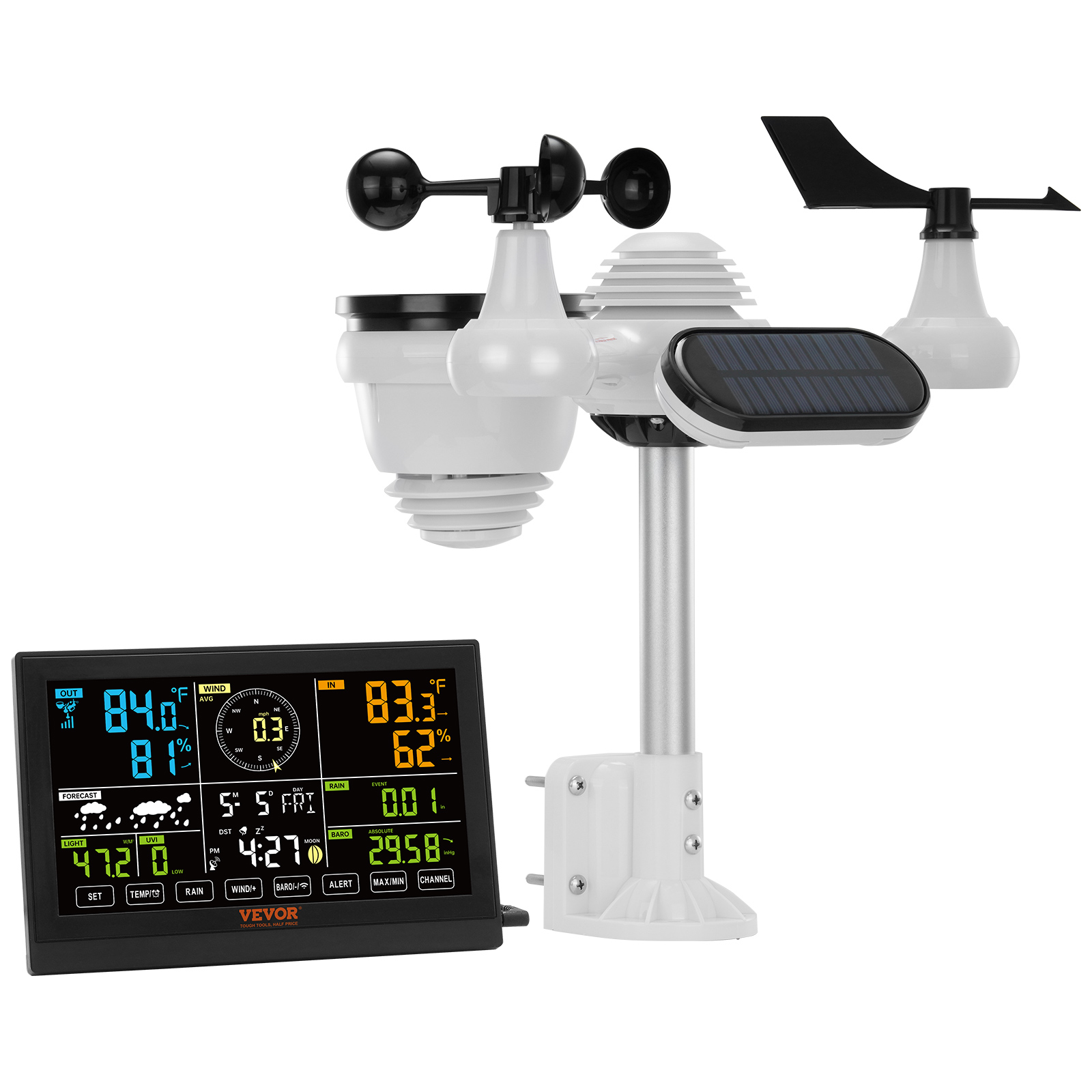

Photos from current listings. Actual item, color, and included accessories may vary.
Home Weather Station Buying Guide
A home weather station is a sensor-to-display system that measures outdoor wind speed/direction, rain, UV, temperature and humidity, then transmits data to an indoor console and often a phone app. The primary trade-off is sensor architecture: ultrasonic or mechanical anemometers with dedicated solar shields and tipping-bucket rain gauges deliver reliable, long-life data, while all-in-one plastic sensor clusters with unshielded thermistors drift and fail within a season or two. The decision rule: buy a station whose outdoor sensor suite uses a radiation shield, a serviceable rain bucket, and a wired or long-range RF link rated for your roof-to-console distance—skip any unit that hides its sensor specs behind a single '7-in-1' label.
Key takeaways
- Sensor architecture: ultrasonic anemometers have no moving cups and resist icing, while mechanical cup-and-vane units are cheaper but wear at the bearing and under-read in gusty conditions.
- Rain measurement: tipping-bucket gauges with a 0.2 mm or 0.01 in resolution and a removable funnel are cleanable and accurate; sealed optical rain sensors drift with dust and cannot be recalibrated.
- Outdoor temperature accuracy depends on a passive radiation shield (louvered or fan-aspirated); unshielded sensors read several degrees high in direct sun and skew humidity and dew point.
At a glance
- Category
- Environmental & Indoor Air Measurement
- Last updated
- Nov 28, 2026
Current offers
Highlights
- Sensor architecture: ultrasonic anemometers have no moving cups and resist icing, while mechanical cup-and-vane units are cheaper but wear at the bearing and under-read in gusty conditions.
- Rain measurement: tipping-bucket gauges with a 0.2 mm or 0.01 in resolution and a removable funnel are cleanable and accurate; sealed optical rain sensors drift with dust and cannot be recalibrated.
- Outdoor temperature accuracy depends on a passive radiation shield (louvered or fan-aspirated); unshielded sensors read several degrees high in direct sun and skew humidity and dew point.
- Wireless range and protocol matter: 868/915 MHz sub-GHz links reach 100–300 m through walls, while 2.4 GHz Wi-Fi sensors are shorter-range and congested; consoles should accept at least 3 remote channels for multi-room or soil/leaf sensors.
Best use cases
- Best fit: a rooftop or pole-mounted ultrasonic station with solar shield and tipping bucket for homeowners who want accurate wind, rain and UV for irrigation, solar-panel or drone-flight decisions—skip decorative indoor-only 'weather clocks'.
- Best fit: a mid-tier mechanical cup/vane station with a color console and app for gardeners tracking frost, rainfall totals and spray windows; choose one with a replaceable rain funnel and at least 100 m RF range.
- Wrong fit: a single all-in-one sensor with no radiation shield and a sealed rain chamber for coastal or dusty climates—salt and grit destroy unshielded thermistors and optical rain sensors within months.
- Wrong fit: buying a station without checking console-to-sensor distance and roof obstructions; a 2.4 GHz Wi-Fi sensor at 30 m through two walls drops packets and loses rain tips during storms.
Buying tips
- Match sensor range to your mounting math: measure roof-to-console distance, add 30% for wall penetration, and require an RF link rated at least that far—sub-GHz units typically reach 100–300 m line-of-sight.
- Insist on a radiation shield and a tipping-bucket rain gauge with a removable funnel; these two parts determine temperature and rain accuracy and are the first to fail on cheap sealed clusters.
- For wind, choose ultrasonic if you get ice or salt spray, mechanical cups if budget is tight—mechanical bearings should be serviceable or the unit treated as a 2–4 season consumable.
- Check console and app data: a station should log min/max, rain rate and rain total, and export or display barometric pressure trend; UV and solar radiation sensors are worth it only if you track sun exposure or PV output.
Specs
| Anemometer Type | Ultrasonic vs cup-and-vane mechanical |
|---|---|
| Rain Sensor | Tipping bucket 0.2 mm vs optical sealed |
| Temp Sensor Shield | Louvered passive vs fan-aspirated |
| Wireless Link | Sub-GHz 100-300 m vs 2.4 GHz Wi-Fi |
Related searches
What to check before buying
- Measure the mounting height and horizontal distance from the outdoor sensor to the indoor console; confirm the stated RF range exceeds it through your wall construction.
- Verify you have a pole or mast (typically 1–1.5 in diameter) and mounting hardware; most stations ship with a bracket but not the mast.
- Check climate compatibility: ultrasonic sensors for icing climates, shielded thermistors for sunny sites, and a rain gauge that can be removed for winter if you get hard freezes.
- Confirm power: consoles are usually USB- or battery-powered, outdoor sensors solar or battery; ensure the sensor's battery type and solar panel orientation suit your latitude and shade.
FAQ
Data sources: eBay / Amazon listings and product attribute feeds. Updated Nov 28, 2026.
Some links on this page are affiliate links. If you buy after clicking one, we may earn a commission at no extra cost to you. This does not change which products appear here or their order. Affiliate disclosure.