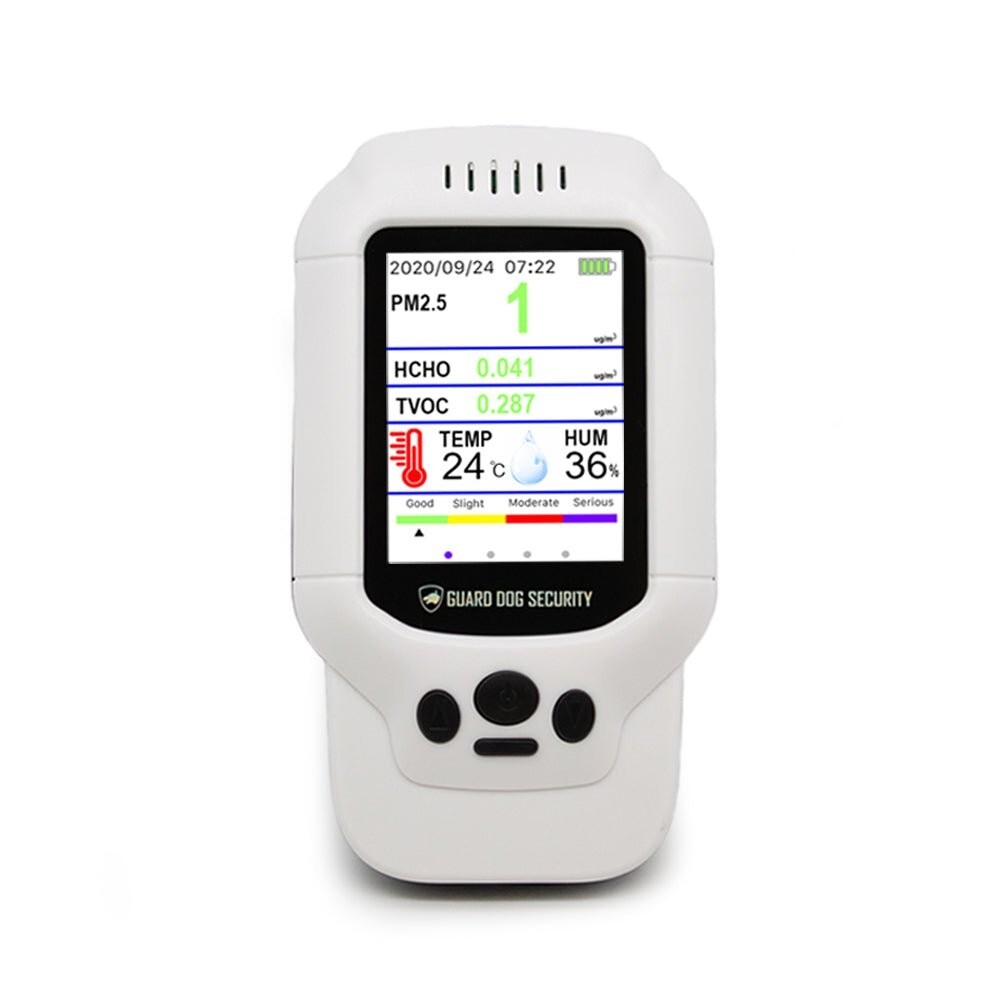

Photos from current listings. Actual item, color, and included accessories may vary.
Outdoor Air Quality Sensor Buying Guide
An outdoor air quality sensor measures particulate matter (PM2.5/PM10) and often gases like ozone or nitrogen dioxide to tell you what you're actually breathing outside. The core trade-off is between optical particle counters with true laser scattering versus low-cost VOC-index sensors that cannot distinguish pollutant types or sizes. Choose a laser-scattering PM sensor with published accuracy (e.g., ±10% or ±5 µg/m³) and weather-rated housing; skip anything that only reports a generic "air quality index" without PM2.5 and PM10 raw values.
Key takeaways
- Laser scattering (nephelometry) counts particles by size and reports PM1.0/2.5/10; low-cost metal-oxide VOC sensors only output a relative index and drift with humidity and temperature.
- Outdoor units need IP65 or better housing and an operating range down to -10°C to -20°C; indoor-only sensors fail in rain, frost, and direct sun.
- PM2.5 accuracy is typically stated as ±10% of reading or ±5–10 µg/m³; sensors without a stated accuracy figure are uncalibrated hobby-grade.
At a glance
- Category
- Environmental & Indoor Air Measurement
- Last updated
- Nov 28, 2026
Current offers
Highlights
- Laser scattering (nephelometry) counts particles by size and reports PM1.0/2.5/10; low-cost metal-oxide VOC sensors only output a relative index and drift with humidity and temperature.
- Outdoor units need IP65 or better housing and an operating range down to -10°C to -20°C; indoor-only sensors fail in rain, frost, and direct sun.
- PM2.5 accuracy is typically stated as ±10% of reading or ±5–10 µg/m³; sensors without a stated accuracy figure are uncalibrated hobby-grade.
- Connectivity tiers: Wi-Fi (2.4 GHz only on most units) for fixed home mounting, LoRaWAN or NB-IoT for long-range low-power sites, and Bluetooth for local only.
Best use cases
- Best fit: fixed backyard or balcony monitoring of wildfire smoke and traffic PM2.5 — pick a Wi-Fi laser PM sensor with IP65 housing and AC or solar power.
- Best fit: comparing indoor vs outdoor air before opening windows — choose a unit that logs PM2.5 history over 24 hours and syncs to an app; skip single-reading handhelds.
- Wrong fit: regulatory or health-compliance reporting — consumer sensors are not reference-grade; you need a certified FEM/equivalence-method monitor.
- Wrong fit: long-range remote field sites without mains power — use LoRaWAN/NB-IoT sensors with battery or solar, not Wi-Fi units that drop off beyond router range.
Buying tips
- Match the particle channel to your concern: PM2.5 for smoke and combustion, PM10 for dust and pollen; a sensor listing only "AQI" with no PM values cannot separate these.
- Check the stated accuracy and resolution: ±10% or ±5 µg/m³ and 1 µg/m³ resolution is usable; ±20% or unspecified means treat readings as trend-only.
- For fixed outdoor mounting, require IP65+ ingress rating and an operating temperature at least 5°C below your local winter minimum.
- Wi-Fi sensors are 2.4 GHz only — confirm your router broadcasts a 2.4 GHz SSID within range, or choose LoRaWAN/NB-IoT for sites beyond about 30–50 m through walls.
Specs
| Sensor Type | Laser scattering vs metal-oxide VOC |
|---|---|
| Particle Channels | PM1.0 / PM2.5 / PM10 |
| PM2.5 Accuracy | ±10% or ±5 µg/m³ |
| Outdoor Rating | IP65+ / -10°C to 50°C |
Related searches
What to check before buying
- Measure your mounting spot: sensor needs unobstructed airflow 1–2 m from walls and away from dryer vents or car exhaust for representative PM2.5.
- Confirm power: most fixed outdoor units need a nearby outlet or a solar/battery kit rated for your latitude's winter sun hours.
- Check climate rating: operating range must cover your record low and high, and housing must be UV-stable if in direct sun.
- Verify data access: confirm the app or API supports history export and third-party integration (e.g., Home Assistant, Weather Underground) if you want automation.
FAQ
Data sources: eBay / Amazon listings and product attribute feeds. Updated Nov 28, 2026.
Some links on this page are affiliate links. If you buy after clicking one, we may earn a commission at no extra cost to you. This does not change which products appear here or their order. Affiliate disclosure.