
Photos from current listings. Actual item, color, and included accessories may vary.
Outdoor Weather Station Buying Guide
Outdoor weather stations range from simple wireless thermo-hygrometer kits to full 7-in-1 sensor arrays that log wind, rain, UV, and barometric pressure. The core trade-off is sensor architecture and wireless range versus display quality and data logging depth: cheap 433 MHz thermo kits cap out around 100–200 ft and lack wind/rain, while 915 MHz or Wi-Fi arrays reach 300–500 ft and add app logging. Choose a true 7-in-1 array if you need wind and rain data; choose a basic wireless thermometer-only kit only if temperature and humidity are the sole requirement.
Median $43.99
Key takeaways
- Sensor arrays split into 5-in-1 (temp, humidity, wind speed/direction, rain) and 7-in-1 (adds UV and solar radiation) — UV/solar channels only matter for garden, solar-panel, or sun-exposure tracking.
- Wireless range is governed by frequency and antenna: 433 MHz kits typically reach 100–200 ft line-of-sight, while 915 MHz or Wi-Fi-connected stations reach 300–500 ft and survive two exterior walls.
- Rain gauges are either tipping-bucket (self-emptying, resolution 0.01 in) or capacitive — tipping-bucket is the durable standard; capacitive units drift and need recalibration.
At a glance
- Category
- Environmental & Indoor Air Measurement
- Last updated
- Nov 28, 2026
Current offers
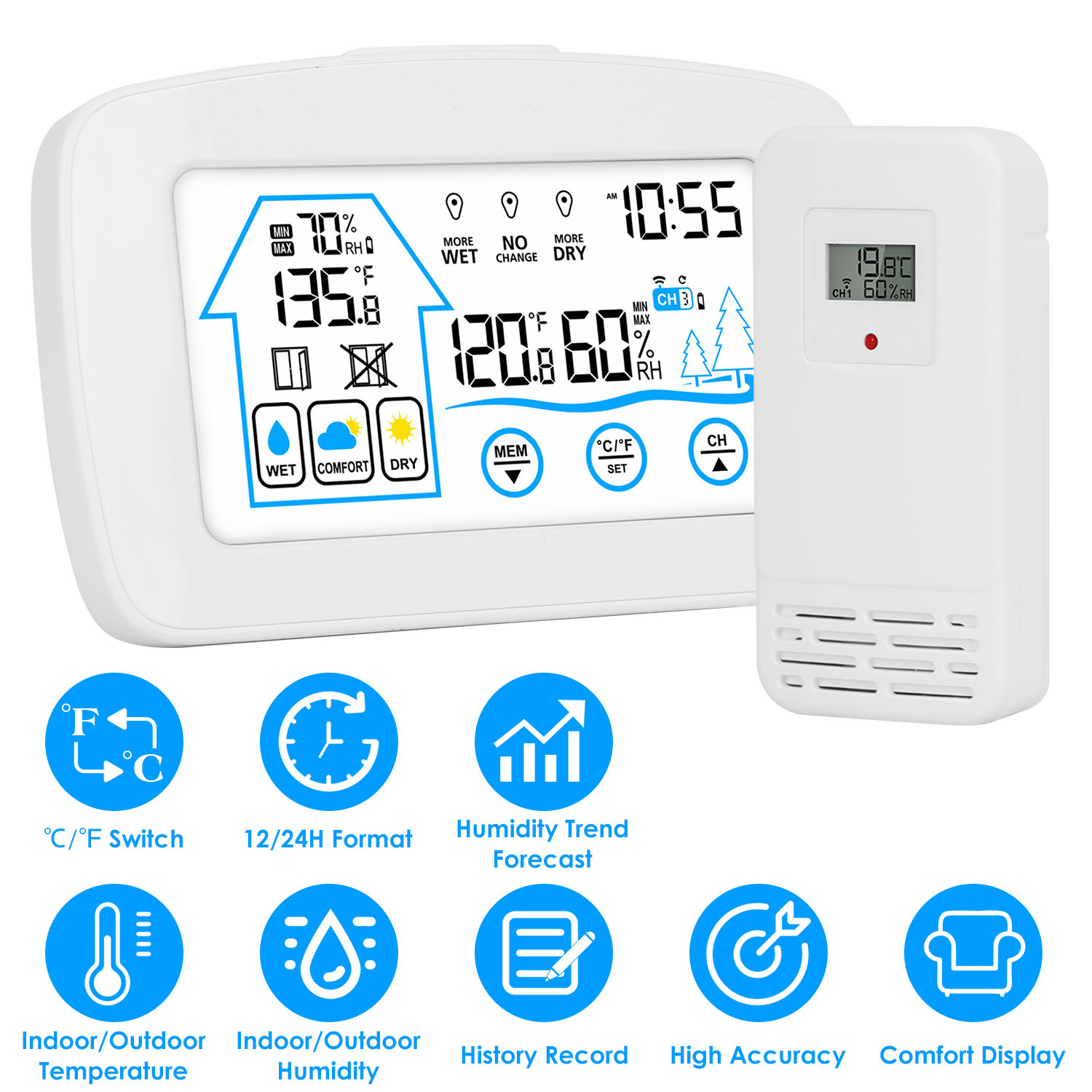 1Pc Wireless Weather Station With Clock 196FT Range Indoor Outdoor Thermometer Sensor Temperature And Humidity Monitor Forecast Battery Powered Backlight Display$39.99View on Mallflare
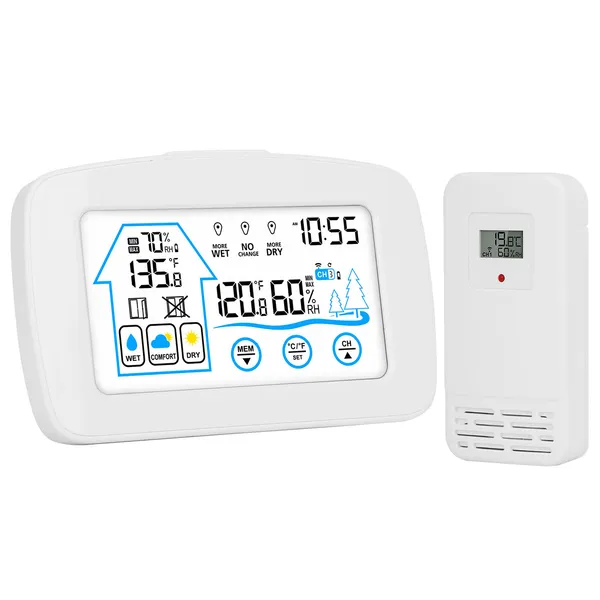 Wireless Weather Station With Clock 196FT Range Indoor Outdoor Thermometer Sensor Temperature And Humidity Monitor Forecast Battery Powered Backlight Display$43.99View on Mallflare
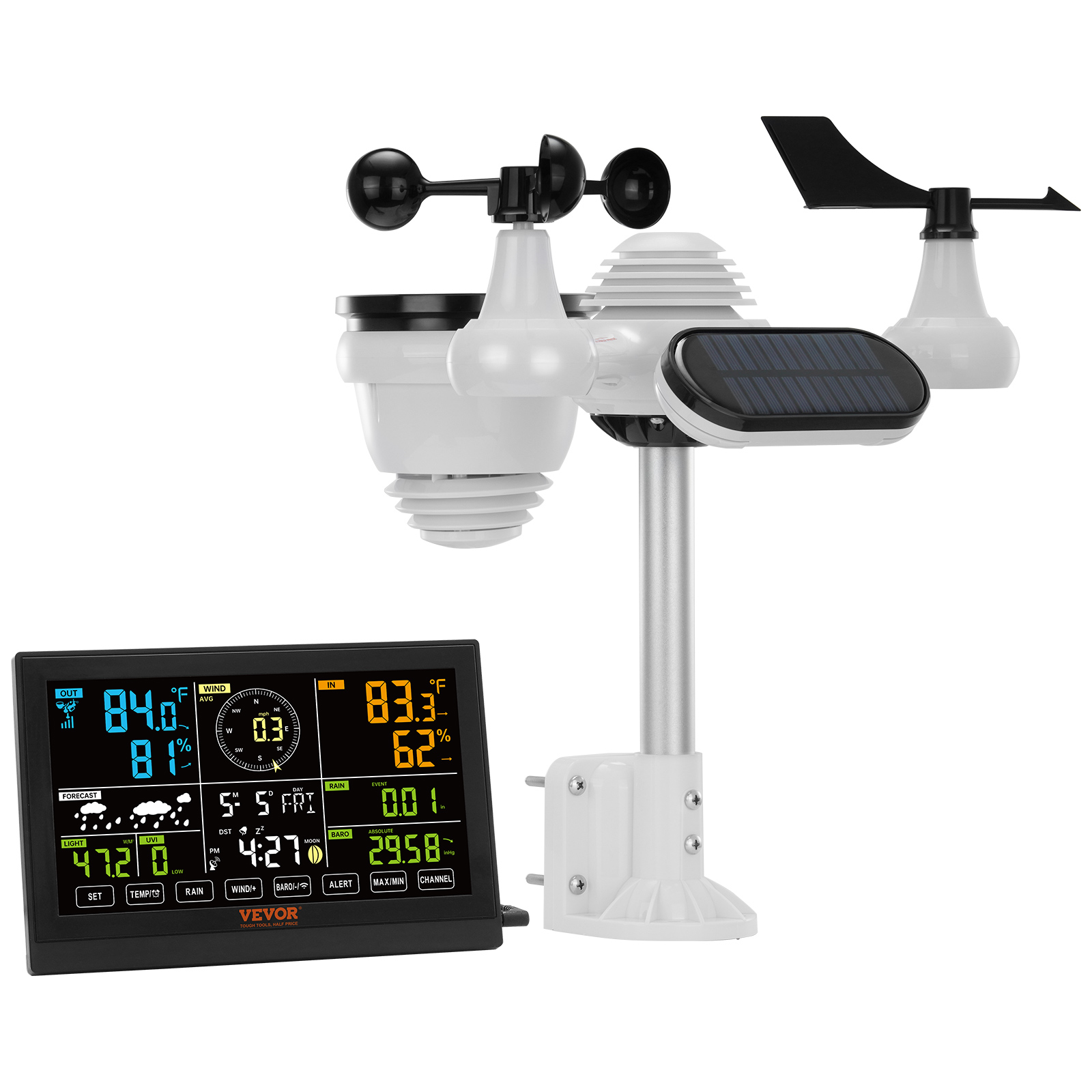 VEVOR 7-in-1 Wireless Weather Station, 7.5 In Large Color Display, Digital Home Indoor Outdoor, For Temperature Humidity Wind Speed,Direction Rain UV, With Forecast Data, Alarm, Alerts$112.99View on Mallflare
Highlights
- Sensor arrays split into 5-in-1 (temp, humidity, wind speed/direction, rain) and 7-in-1 (adds UV and solar radiation) — UV/solar channels only matter for garden, solar-panel, or sun-exposure tracking.
- Wireless range is governed by frequency and antenna: 433 MHz kits typically reach 100–200 ft line-of-sight, while 915 MHz or Wi-Fi-connected stations reach 300–500 ft and survive two exterior walls.
- Rain gauges are either tipping-bucket (self-emptying, resolution 0.01 in) or capacitive — tipping-bucket is the durable standard; capacitive units drift and need recalibration.
- Display size and backlight are separate specs from sensor count: a 7.5 in color console with adjustable backlight is the practical minimum for at-a-glance multi-variable reading; mono LCDs are cheaper but harder to read at distance.
Best use cases
- Best fit: a homeowner wanting wind speed, rainfall, and forecast trends should pick a 7-in-1 solar-assisted array with 915 MHz or Wi-Fi link and a color console — skip 3-in-1 thermo kits that omit anemometer and rain bucket.
- Best fit: a gardener or solar-panel owner tracking UV index and irradiance should choose a 7-in-1 array with dedicated UV and solar-radiation channels; a 5-in-1 without UV cannot report sun exposure.
- Wrong fit: an apartment dweller with no exterior mounting point should skip full arrays and use a single wireless thermo-hygrometer sensor placed on a balcony — mast-mounted anemometers need 10+ ft of clear vertical clearance.
Buying tips
- Match wireless range to mounting distance with margin: a sensor 80 ft from the console through two walls needs a 300 ft-rated 915 MHz or Wi-Fi station, not a 100 ft 433 MHz kit.
- Pick tipping-bucket rain gauges over capacitive; tipping-bucket resolution of 0.01 in per tip is the durable, field-serviceable standard for accurate accumulation.
- For wind accuracy, the sensor mast must sit at least 10 ft above the roofline and 30 ft from tall obstructions — budget a mounting pole and bracket as a companion part.
- Choose solar-assisted arrays in climates with regular sun to extend battery life; in heavy overcast or deep-freeze regions, confirm the array accepts lithium AA/CR123 cells rated to −4°F.
Specs
| Sensor Array | 3-in-1 to 7-in-1 (wind/rain/UV tiers) |
|---|---|
| Wireless Link | 433 MHz / 915 MHz / Wi-Fi |
| Rain Gauge Type | Tipping-bucket vs capacitive |
| Console Display | Mono LCD to 7.5 in color backlit |
Related searches
What to check before buying
- Measure the mounting height and horizontal distance from console to intended mast location; confirm the station's rated wireless range exceeds that distance by at least 2x.
- Verify exterior wall count and material between sensor and console — 433 MHz signals lose range through masonry and metal siding faster than through wood-frame walls.
- Confirm the sensor array's operating temperature range covers your local winter minimum, especially for lithium battery performance below freezing.
- Check that the package includes or specifies a mounting pole diameter and bracket; most arrays clamp to 1–1.25 in poles sold separately.
FAQ
Data sources: eBay / Amazon listings and product attribute feeds. Updated Nov 28, 2026.
Some links on this page are affiliate links. If you buy after clicking one, we may earn a commission at no extra cost to you. This does not change which products appear here or their order. Affiliate disclosure.