
Photos from current listings. Actual item, color, and included accessories may vary.
Infrared Laser Thermometer Buying Guide
Infrared laser thermometers are non-contact surface-temperature tools that convert emitted IR energy into a reading, with accuracy and durability determined by the detector type, optical resolution (distance-to-spot ratio), and emissivity adjustment. The core trade-off is single-point IR convenience versus the need for contact probes or high-D:S optics on reflective or distant targets. Buy a model with adjustable emissivity and a known D:S ratio for your working distance; skip fixed-emissivity toy guns for metal, glass, or outdoor use.
Median $50.99
Key takeaways
- Detector architecture: thermopile sensors dominate handheld IR guns; 8-14 µm spectral response suits most surfaces, while short-wave sensors are needed for glass and thin-film plastics.
- Optical resolution (D:S) sets spot size: a 12:1 gun reads a 1-inch spot at 12 inches, so distant or small targets demand 30:1 or 50:1 optics to avoid averaging errors.
- Emissivity control separates serious meters from fixed-0.95 toys: adjustable 0.10-1.00 settings are mandatory for bare metals, which need low-e correction or a K-type contact probe.
At a glance
- Category
- Industrial Gauges & Meters
- Last updated
- Nov 28, 2026
Current offers
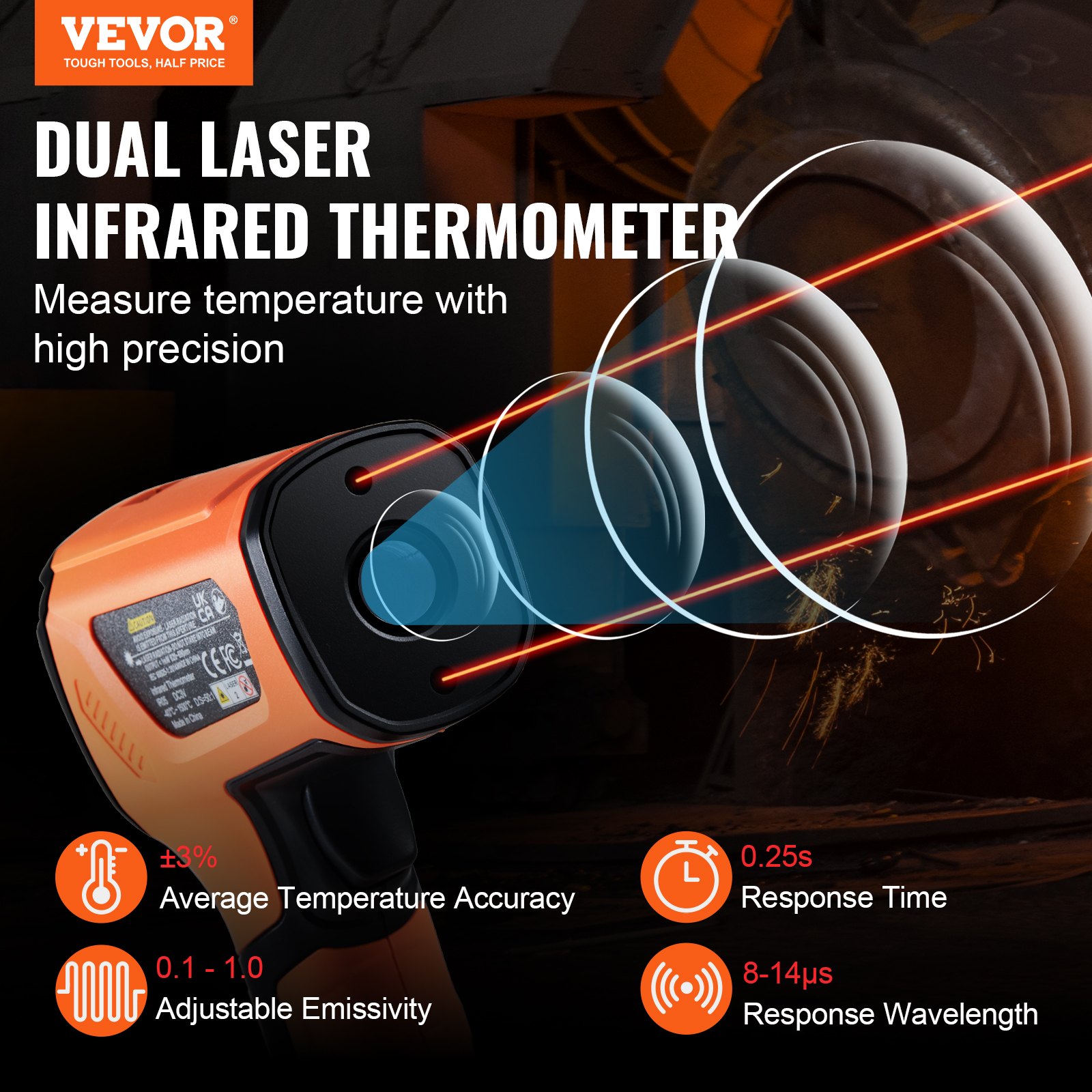 Infrared Thermometer, Dual Laser Temperature Gun Non-Contact, Handheld IR Heat Gun With Adjustable Emissivity$45.99View on Mallflare
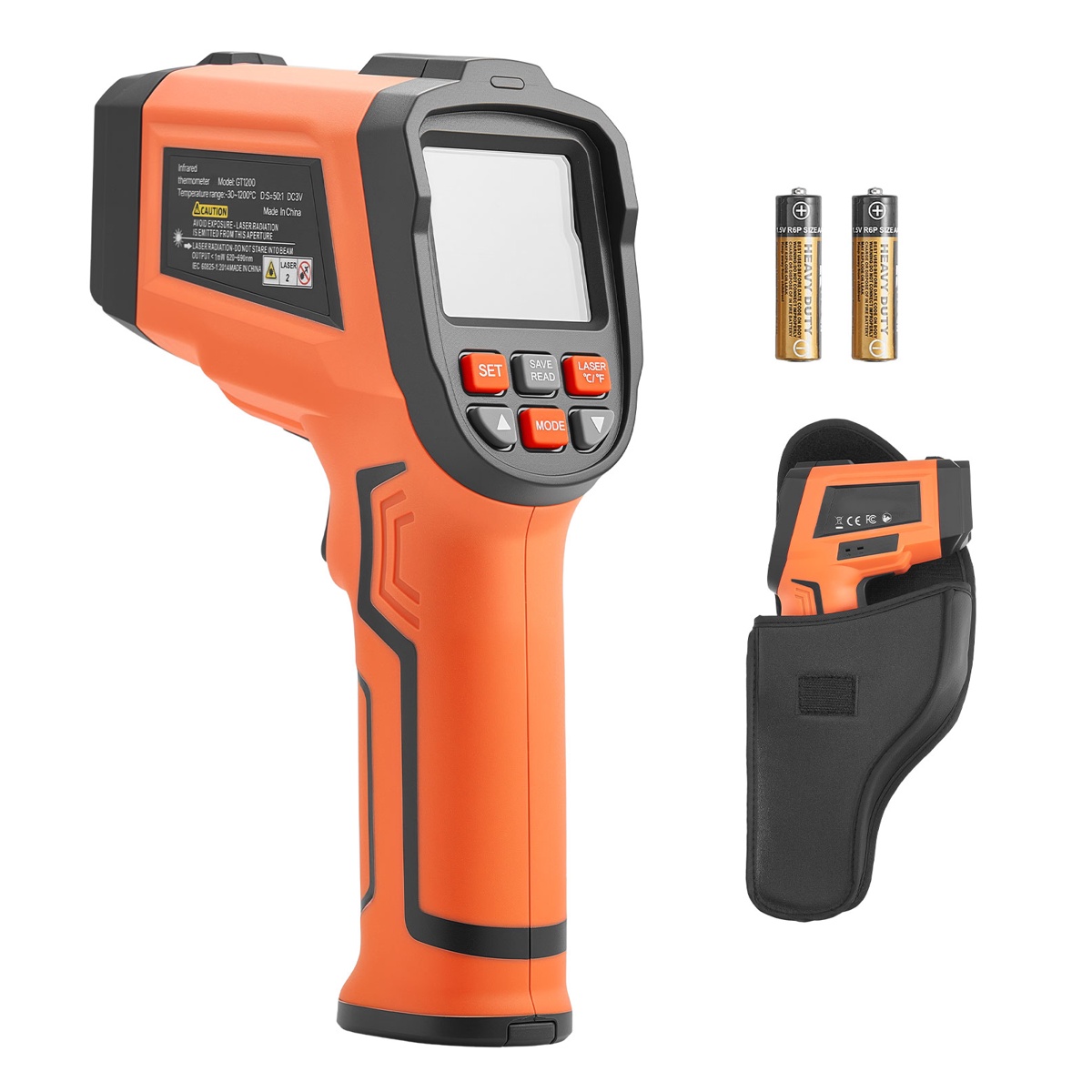 Infrared Thermometer, -22℉ To 2912℉ Dual-Mode IR Gun With K-Type Thermocouple, Dual Laser Heat Temperature Gun Non-Contact For Metal Smelting/Engine/Industry/Cooking (Not For Human)$55.99View on Mallflare
Highlights
- Detector architecture: thermopile sensors dominate handheld IR guns; 8-14 µm spectral response suits most surfaces, while short-wave sensors are needed for glass and thin-film plastics.
- Optical resolution (D:S) sets spot size: a 12:1 gun reads a 1-inch spot at 12 inches, so distant or small targets demand 30:1 or 50:1 optics to avoid averaging errors.
- Emissivity control separates serious meters from fixed-0.95 toys: adjustable 0.10-1.00 settings are mandatory for bare metals, which need low-e correction or a K-type contact probe.
- Dual-laser aiming shows spot boundaries, not just a center dot, and a K-type thermocouple input extends range to contact measurement up to roughly 2500°F for smelting and engine work.
Best use cases
- Metal smelting, engine diagnostics, and industrial process checks: pick a dual-laser IR gun with adjustable emissivity plus a K-type thermocouple port; skip fixed-emissivity consumer guns that misread shiny metal by hundreds of degrees.
- Cooking, HVAC vents, and home insulation: a 12:1 to 16:1 IR gun with 0.1-1.0 emissivity covers searing pans and ductwork; skip high-D:S industrial models unless you also need distant electrical-panel scanning.
- Electrical inspection and automotive brakes: choose 30:1 or better optics and a wide -22°F to 1000°F+ range for safe standoff distance; a 6:1 or 8:1 close-focus gun is wrong here because spot size blurs small components.
- Human fever screening: skip IR surface guns entirely; clinical thermometers use different calibration and body-mode algorithms, and surface IR readings on skin are not diagnostic.
Buying tips
- Compute spot size before buying: multiply working distance by 1/D:S. A 12:1 gun at 24 inches reads a 2-inch circle; if your target is smaller, step up to 30:1 or move closer.
- Require adjustable emissivity from 0.10 to 1.00 for any metal, glass, or polished-surface work; fixed 0.95 models are only accurate on matte organic materials like wood, food, and painted walls.
- Match temperature range to the task with headroom: 2912°F (1600°C) dual-mode units cover smelting and engine exhaust, while -22°F to 1000°F models handle HVAC, cooking, and electrical panels.
- Pick dual-laser aiming for small or distant targets and confirm K-type thermocouple input if you need contact readings on bare metal, where IR alone is unreliable.
Specs
| Detector Type | Thermopile IR 8-14 µm |
|---|---|
| Optics D:S Ratio | 6:1 to 50:1 |
| Emissivity Range | Fixed 0.95 vs 0.10-1.00 adj. |
| Temp Range | -22°F to 2912°F dual-mode |
Related searches
What to check before buying
- Measure your farthest target distance and smallest target diameter, then confirm the meter's D:S ratio keeps spot size below that diameter.
- Identify target surface finish: shiny metal or glass requires adjustable emissivity near 0.10-0.30 or a contact probe; matte surfaces work at 0.90-0.95.
- Confirm the temperature range covers your hottest expected reading with at least 20% headroom for accuracy and sensor longevity.
- Check whether you need a K-type thermocouple probe, and verify the meter includes or accepts the standard mini-plug connector.
FAQ
Data sources: eBay / Amazon listings and product attribute feeds. Updated Nov 28, 2026.
Some links on this page are affiliate links. If you buy after clicking one, we may earn a commission at no extra cost to you. This does not change which products appear here or their order. Affiliate disclosure.