
Photos from current listings. Actual item, color, and included accessories may vary.
Infrared Thermometer Buying Guide
Infrared thermometers are non-contact surface-temperature tools whose accuracy hinges on distance-to-spot ratio and emissivity calibration, not on the highest advertised temperature range. The core trade-off is optical resolution versus price: tight-spot guns with adjustable emissivity read small or reflective targets reliably, while wide-spot fixed-emissivity units are only trustworthy on matte, close-up surfaces. Choose a gun with a distance-to-spot ratio of at least 12:1 and adjustable emissivity for cooking, HVAC, and metal; accept 8:1 fixed-emissivity only for coarse bulk scans.
Median $50.99
Key takeaways
- Optical resolution is defined by distance-to-spot (D:S) ratio: a 12:1 gun reads a 1-inch spot at 12 inches, while an 8:1 gun averages a 2-inch area at 16 inches, blending hot and cold zones.
- Adjustable emissivity (0.10–1.00) is mandatory for shiny metal, glass, and polished griddle plates; fixed 0.95 units under-read reflective surfaces by 30–70 percent.
- Dual-laser aiming brackets the true measurement circle only on models where the lasers converge at the D:S focal point; single-dot lasers mark the center, not the spot edge.
At a glance
- Category
- Industrial Gauges & Meters
- Last updated
- Nov 28, 2026
Current offers
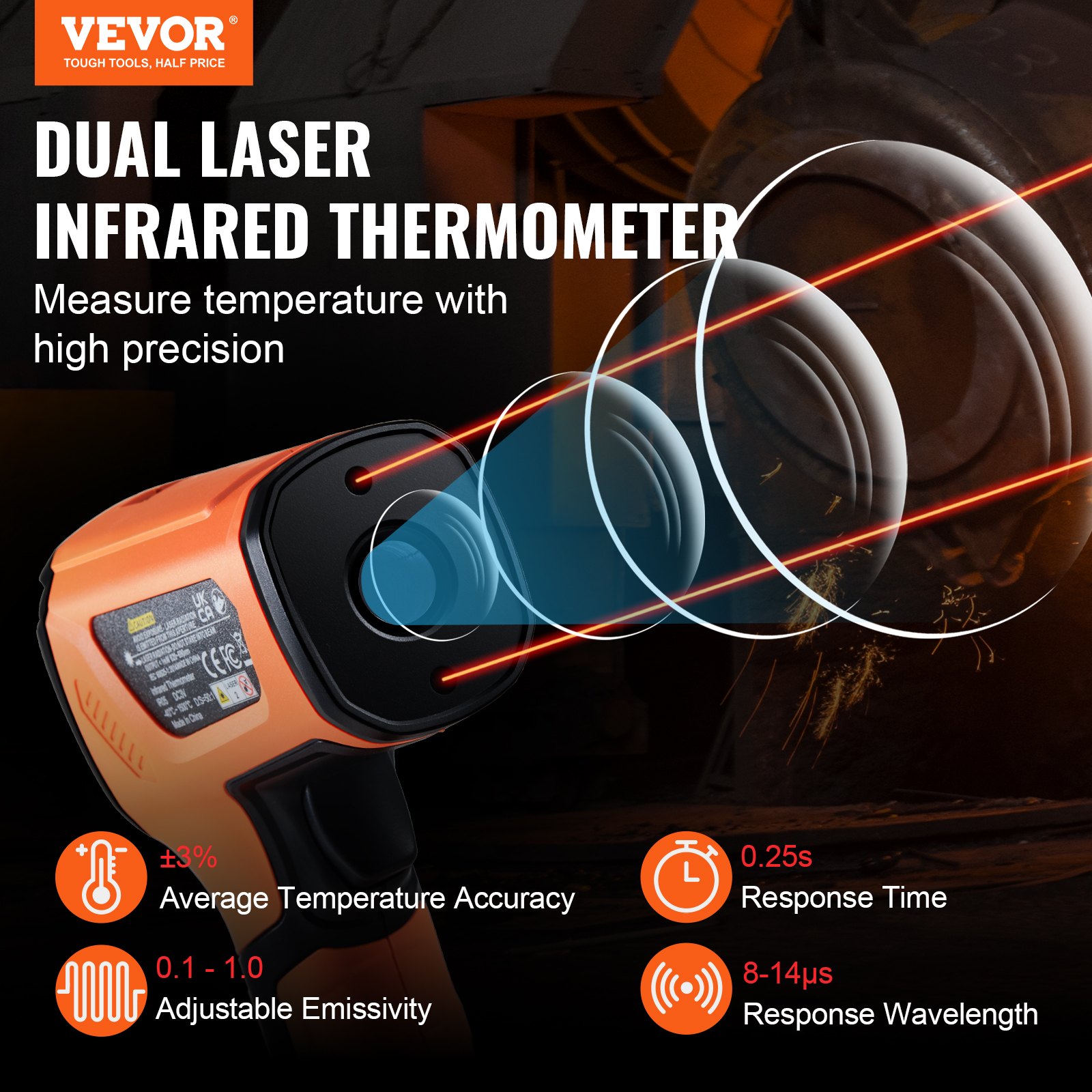 Infrared Thermometer, Dual Laser Temperature Gun Non-Contact, Handheld IR Heat Gun With Adjustable Emissivity$45.99View on Mallflare
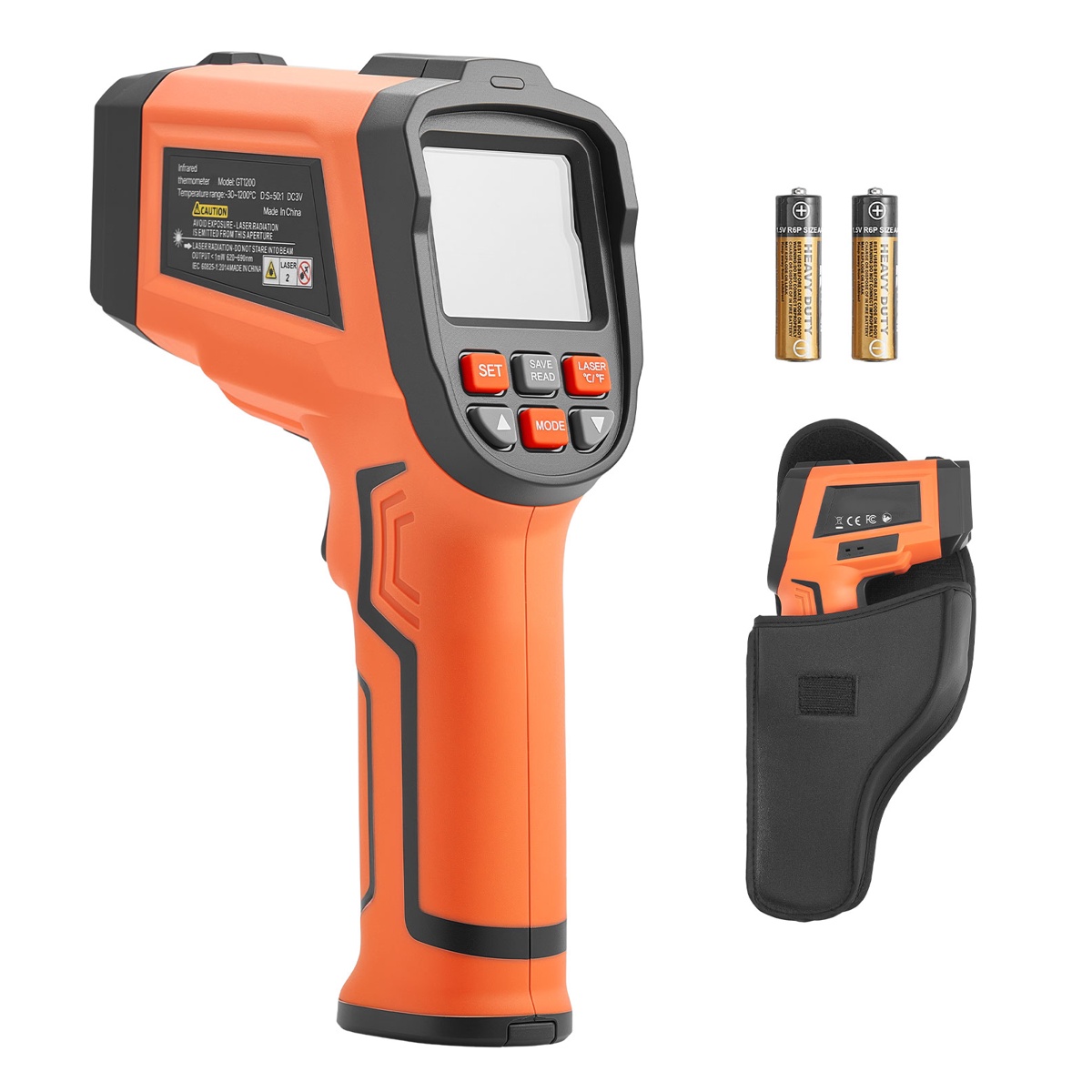 Infrared Thermometer, -22℉ To 2912℉ Dual-Mode IR Gun With K-Type Thermocouple, Dual Laser Heat Temperature Gun Non-Contact For Metal Smelting/Engine/Industry/Cooking (Not For Human)$55.99View on Mallflare
Highlights
- Optical resolution is defined by distance-to-spot (D:S) ratio: a 12:1 gun reads a 1-inch spot at 12 inches, while an 8:1 gun averages a 2-inch area at 16 inches, blending hot and cold zones.
- Adjustable emissivity (0.10–1.00) is mandatory for shiny metal, glass, and polished griddle plates; fixed 0.95 units under-read reflective surfaces by 30–70 percent.
- Dual-laser aiming brackets the true measurement circle only on models where the lasers converge at the D:S focal point; single-dot lasers mark the center, not the spot edge.
- K-type thermocouple inputs (typically -58 to 1832°F) add contact probes for internal food temps and pipe-surface reads where IR cannot penetrate; dual-mode IR plus probe covers both surface and core.
Best use cases
- Blackstone griddle and cast-iron cooking: pick a 12:1 or tighter gun with adjustable emissivity set to 0.80–0.90 for seasoned steel; skip fixed-emissivity 8:1 units that average the cooler zone beside the hot spot.
- HVAC diagnostics: choose a gun with 12:1 or better D:S, min/max hold, and a K-type probe port to read supply/return air registers and refrigerant line surfaces; skip wide-spot 6:1 or 8:1 units for duct and coil work.
- Grilling and pizza steel: a dual-laser 12:1 gun with 0.1–1.0 emissivity and a 500 ms response reads steak sear and stone temps; skip 2912°F-rated smelting guns whose wide spectral band is calibrated for hot metal, not food surfaces.
- Metal smelting and engine work: an IR gun rated to 2912°F with a K-type contact probe handles exhaust and forge surfaces; skip consumer cooking guns rated to only 700–1000°F for these tasks.
Buying tips
- Calculate your target spot: divide the distance by the D:S ratio. At 18 inches, a 12:1 gun reads a 1.5-inch circle; an 8:1 gun reads 2.25 inches and can miss a small griddle hot zone.
- Match emissivity to material: set 0.95 for matte food and painted surfaces, 0.80–0.90 for seasoned steel, and 0.10–0.30 for polished aluminum or chrome; fixed 0.95 guns cannot do this.
- Demand a response time of 500 ms or faster and a repeatability spec of ±1°F or ±1 percent; slower sensors drift on moving targets like grill grates.
- For hot-metal or forge work, verify the spectral response is short-wavelength (around 1.0–1.6 µm) and the range exceeds 2000°F; standard 8–14 µm cooking guns top out near 1000°F.
Specs
| Distance-to-Spot Ratio | 8:1 to 50:1 (12:1 general use) |
|---|---|
| Emissivity Control | Fixed 0.95 vs adjustable 0.10–1.00 |
| Temperature Range | -22°F to 2912°F by model class |
| Probe Compatibility | K-type thermocouple input on dual-mode |
Related searches
What to check before buying
- Measure the distance from your hand position to the cooking surface or duct port; that distance divided by the D:S ratio must be smaller than your target's width.
- Confirm the target surface finish: matte and dark surfaces read well at 0.95 emissivity, while shiny or reflective surfaces require an adjustable-emissivity gun or a matte tape patch.
- Verify the temperature ceiling exceeds your hottest expected surface by at least 20 percent; griddle searing reaches 500–600°F, while smelting and exhaust work exceeds 1500°F.
- Check the battery type and whether the gun ships with a K-type probe; probe-compatible models need the matching thermocouple plug, not a bare wire.
FAQ
Data sources: eBay / Amazon listings and product attribute feeds. Updated Nov 28, 2026.
Some links on this page are affiliate links. If you buy after clicking one, we may earn a commission at no extra cost to you. This does not change which products appear here or their order. Affiliate disclosure.