
Photos from current listings. Actual item, color, and included accessories may vary.
Laser Thermometer Buying Guide
An infrared laser thermometer measures surface temperature non-contact by sensing emitted IR energy, with a red laser only marking the aim point—not measuring temperature itself. The core trade-off is optical resolution (distance-to-spot ratio) and emissivity compensation versus price: fixed-emissivity 12:1 guns are fine for cooking, while adjustable-emissivity 30:1+ units are required for bare metal and industrial work. The decision rule: if you need to measure shiny metal, cast iron, or engine components accurately, buy an adjustable-emissivity dual-laser model; for food and household surfaces, a fixed-emissivity 12:1 gun is sufficient and safer.
Median $50.99
Key takeaways
- Distance-to-spot (D:S) ratio defines target accuracy: 12:1 gives a 1-inch spot at 12 inches; 30:1 or 50:1 is needed for small or distant industrial targets.
- Laser type matters: single-dot marks center only; dual-laser converges two beams to show the true measurement spot diameter at any distance.
- Emissivity adjustability (0.1–1.0) is mandatory for bare metals (typical ε 0.1–0.3); fixed-ε 0.95 guns read shiny metal far too low.
At a glance
- Category
- Industrial Gauges & Meters
- Last updated
- Nov 28, 2026
Current offers
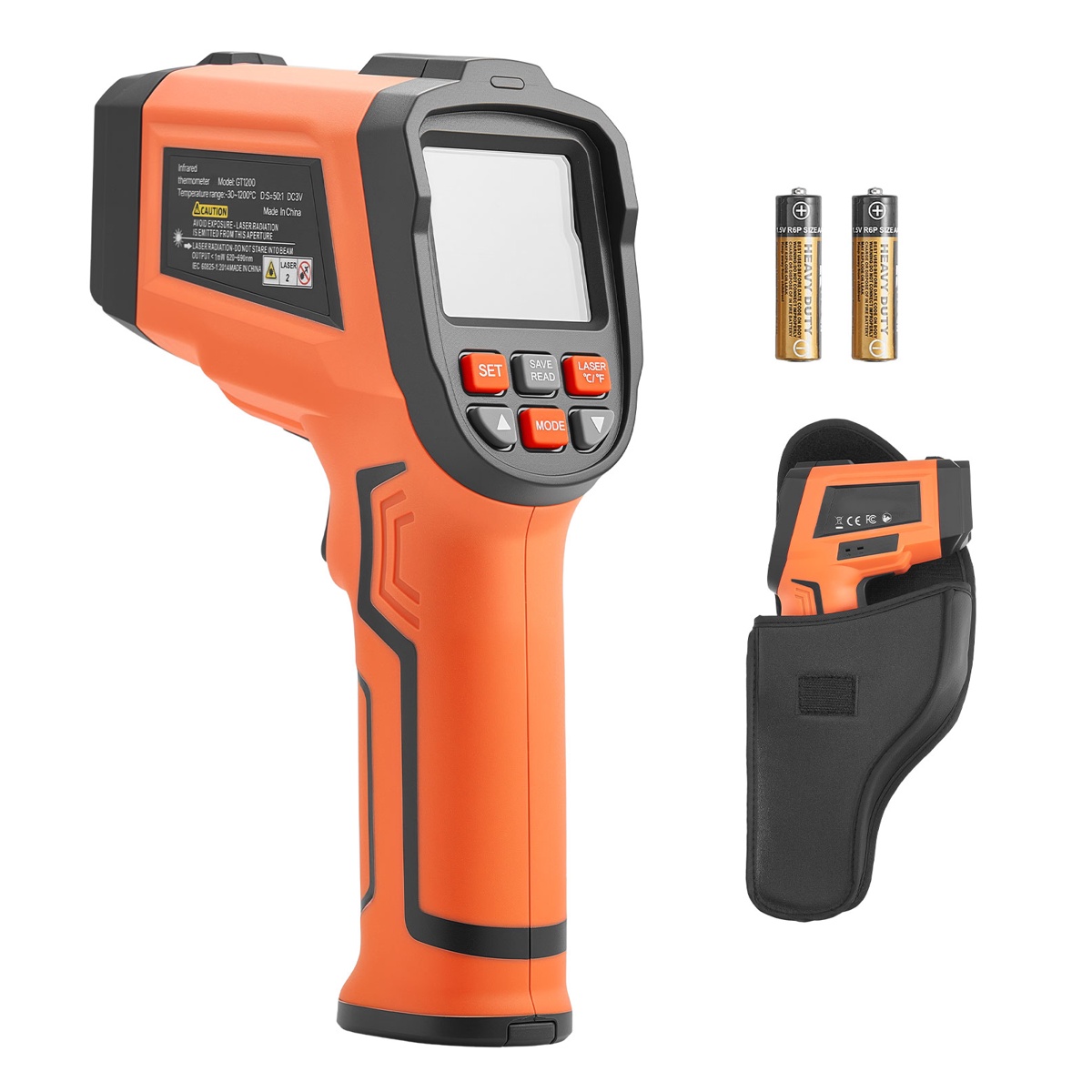
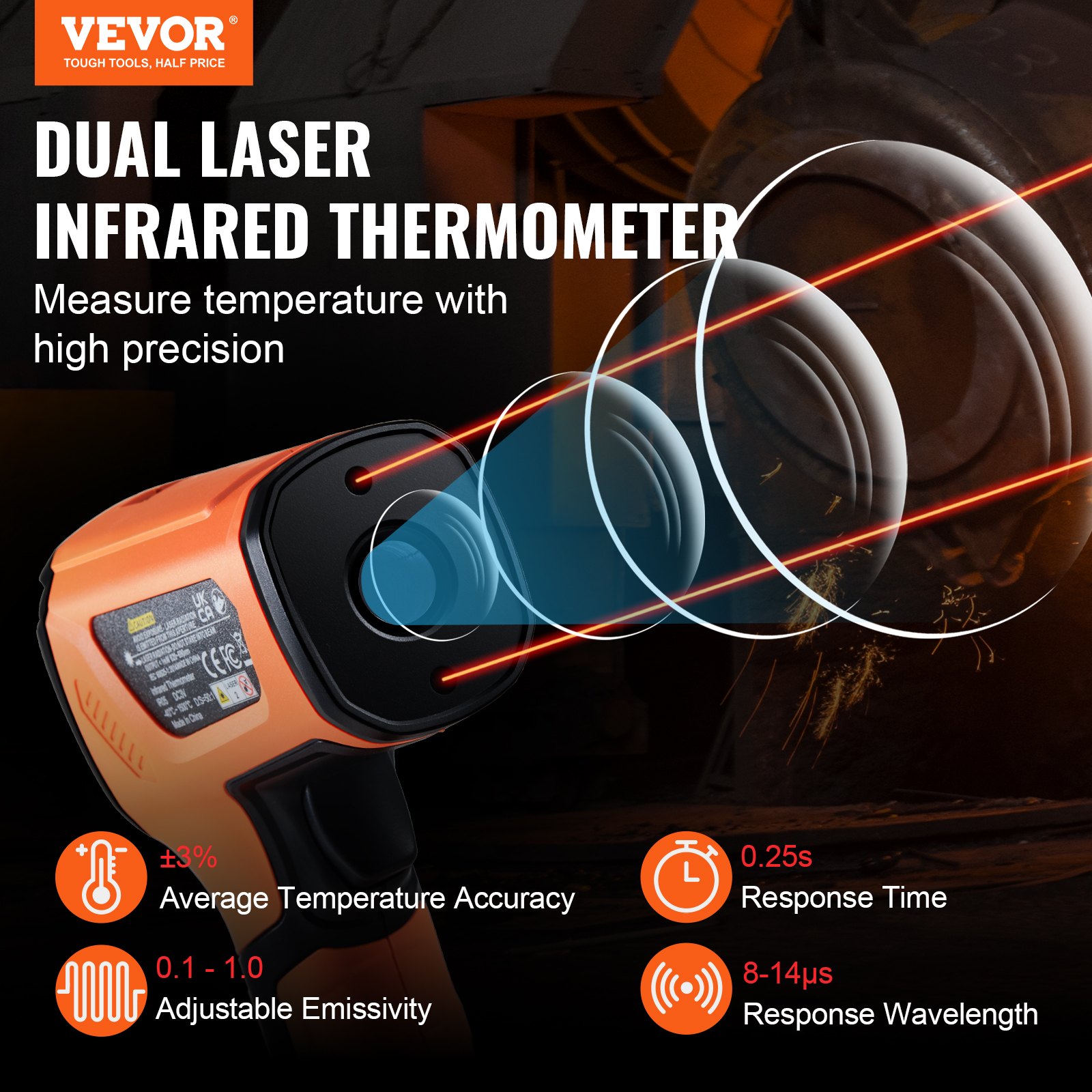 Infrared Thermometer, Dual Laser Temperature Gun Non-Contact, Handheld IR Heat Gun With Adjustable Emissivity$45.99View on Mallflare
 Infrared Thermometer, -22℉ To 2912℉ Dual-Mode IR Gun With K-Type Thermocouple, Dual Laser Heat Temperature Gun Non-Contact For Metal Smelting/Engine/Industry/Cooking (Not For Human)$55.99View on Mallflare
Highlights
- Distance-to-spot (D:S) ratio defines target accuracy: 12:1 gives a 1-inch spot at 12 inches; 30:1 or 50:1 is needed for small or distant industrial targets.
- Laser type matters: single-dot marks center only; dual-laser converges two beams to show the true measurement spot diameter at any distance.
- Emissivity adjustability (0.1–1.0) is mandatory for bare metals (typical ε 0.1–0.3); fixed-ε 0.95 guns read shiny metal far too low.
- K-type thermocouple input on hybrid IR guns enables contact measurement for reflective surfaces where IR is unreliable.
Best use cases
- Cooking and griddle checks: pick a fixed-emissivity 12:1 IR gun with a wide -58°F to 716°F range and FDA-safe housing; skip high-temperature industrial models that overshoot food-surface accuracy.
- Engine, exhaust, and brake diagnostics: choose a dual-laser 20:1+ gun with adjustable emissivity and a max range above 1000°F; skip basic cooking guns with fixed ε 0.95.
- Metal smelting and forge work: select a 30:1+ ratio gun rated to 2000°F+ with adjustable emissivity or a K-type thermocouple probe; a 12:1 fixed-ε gun will under-read glowing metal by hundreds of degrees.
- HVAC and electrical panel checks: a 12:1 to 16:1 gun with 0.1°F resolution and adjustable ε covers duct, register, and breaker temperature sweeps; skip single-dot toys without emissivity control.
Buying tips
- Match D:S ratio to target size: for a 1-inch target at 12 inches you need 12:1; at 60 inches you need 60:1—buy the highest ratio your typical distance demands.
- For bare or shiny metals, require adjustable emissivity down to 0.1 and preferably a K-type thermocouple port; fixed ε 0.95 guns are for organics, painted surfaces, and liquids.
- Check temperature range against your process: cooking and HVAC live under 800°F; engines and brakes need 1200°F+; smelting and forges need 2000°F+ with optical resolution to match.
- Dual-laser aiming is not marketing—it circles the actual spot; single-laser guns require you to calculate spot size from the D:S ratio at every distance.
Specs
| Optical Ratio (D:S) | 12:1 cooking / 30:1+ industrial |
|---|---|
| Emissivity Setting | Fixed 0.95 vs adjustable 0.1–1.0 |
| Temperature Range | -58°F to 2912°F (model dependent) |
| Laser & Probe | Single/dual laser; K-type thermocouple input |
Related searches
What to check before buying
- Measure the distance from your hand position to the hottest target (e.g., grill grate to handle, panel to standing spot) and divide by your target size to set the minimum D:S ratio.
- Confirm the surface material: bare metal, polished chrome, or glass requires adjustable emissivity or contact probe; painted, plastic, food, and water work with fixed ε 0.95.
- Verify the gun's max temperature exceeds your process peak by at least 20% to avoid saturating the sensor at the top of its range.
- Check battery type and whether the unit accepts a K-type probe; hybrid IR+contact models need the matching thermocouple plug standard (mini or standard).
FAQ
Data sources: eBay / Amazon listings and product attribute feeds. Updated Nov 28, 2026.
Some links on this page are affiliate links. If you buy after clicking one, we may earn a commission at no extra cost to you. This does not change which products appear here or their order. Affiliate disclosure.