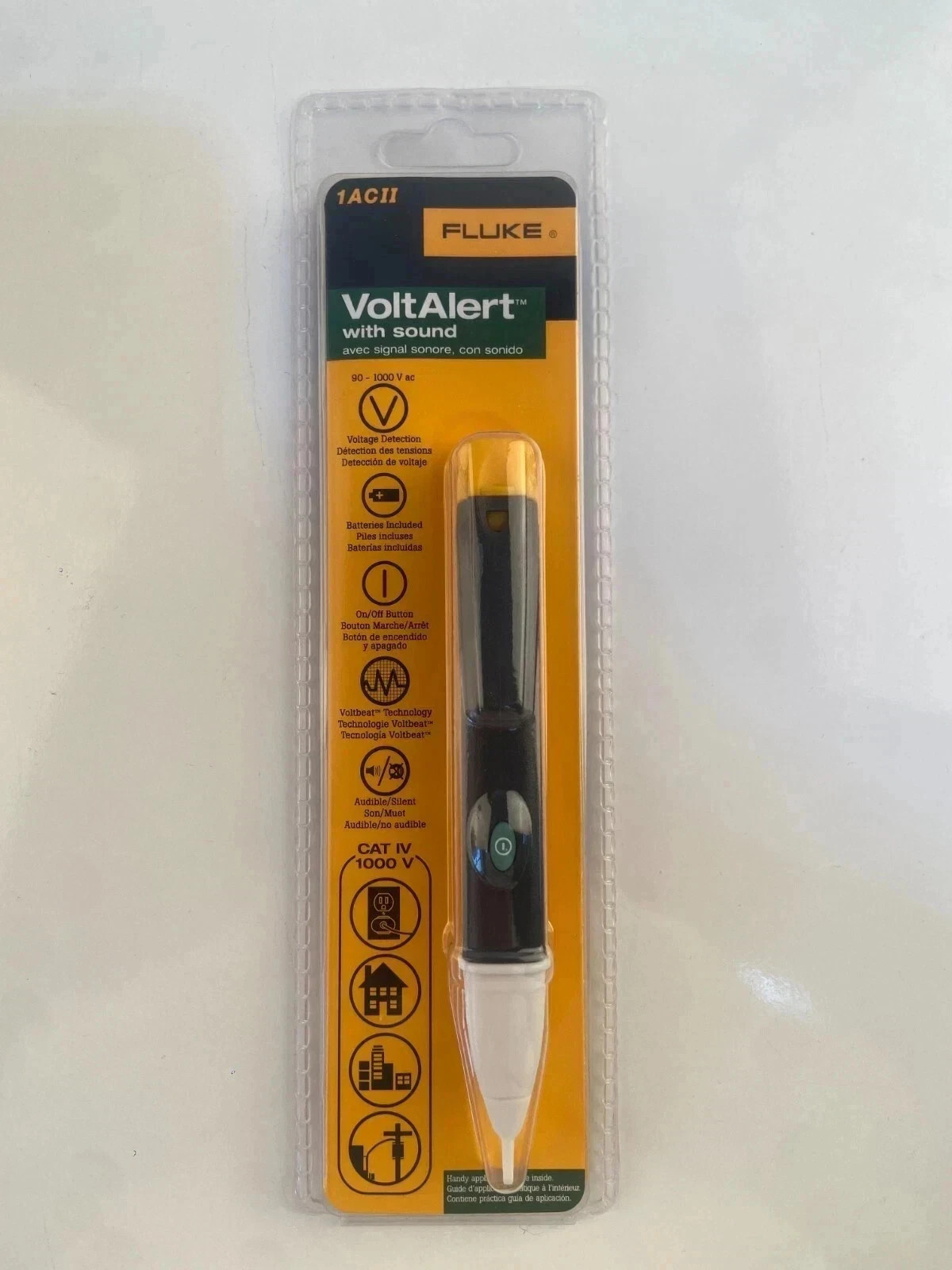

Photos from current listings. Actual item, color, and included accessories may vary.
Fluke 1AC II Buying Guide
The Fluke 1AC II is a pocket-sized non-contact voltage tester that detects AC voltage from 90 to 1000 V without metallic contact. Its core trade-off is sensitivity and safety margin versus false-positive rate: a fixed 90 V threshold with a low-voltage mode gives electricians a clear go/no-go before touching a conductor. Buy the genuine 1AC II when you need a CAT IV-rated sanity check; skip generic testers that lack a defined voltage threshold and continuous self-test circuitry.
Key takeaways
- Detection range is 90-1000 V AC, with a separate low-voltage mode covering 24-90 V AC for thermostat and control wiring.
- Continuous self-test circuitry pulses the sensor and proves the tester is functional before each use; generic pens lack this.
- CAT IV 1000 V rating covers installation-level transients, making it safe at service entrances and outdoor panels.
At a glance
- Category
- Multimeters & Electrical Testers
- Status
- Listings available
- Last updated
- Nov 28, 2026
Current offers
Highlights
- Detection range is 90-1000 V AC, with a separate low-voltage mode covering 24-90 V AC for thermostat and control wiring.
- Continuous self-test circuitry pulses the sensor and proves the tester is functional before each use; generic pens lack this.
- CAT IV 1000 V rating covers installation-level transients, making it safe at service entrances and outdoor panels.
- The 1AC II is a 50/60 Hz AC-only detector; it will not indicate DC voltage or non-sinusoidal drives.
Best use cases
- Best fit: electricians and HVAC techs who need a fast go/no-go before touching a conductor in panels, outlets, or switches rated up to 1000 V AC.
- Best fit: thermostat and 24 V control work, where the low-voltage mode gives a reliable indication that a standard 90 V threshold tester misses.
- Wrong fit: automotive DC, battery, or solar DC troubleshooting—buy a dedicated DC voltage tester or multimeter instead.
- Wrong fit: precise voltage measurement or diagnostics—this is an indicator, not a meter; pair it with a true-RMS multimeter.
Buying tips
- Confirm the model is the 1AC II (not the older 1AC) and that the package includes the low-voltage mode—this is the key functional differentiator.
- Check the CAT rating on the body: genuine units are marked CAT IV 1000 V; an unmarked or CAT II-only tester is not equivalent.
- Buy from authorized distributors with a serial number and Fluke warranty; counterfeit 1AC II units are common on marketplace listings.
- Match the tester to your environment: 90-1000 V AC range suits 120/240/480 V work; for 24 V control circuits rely specifically on low-voltage mode.
Specs
| Detection Range | 90-1000 V AC (50/60 Hz) |
|---|---|
| Low-Voltage Mode | 24-90 V AC |
| Safety Rating | CAT IV 1000 V |
| Tester Type | Non-contact AC voltage detector |
Alternatives to compare
Related searches
What to check before buying
- Verify your expected voltage falls within 90-1000 V AC, or within 24-90 V AC for the low-voltage mode.
- Confirm the work environment is AC 50/60 Hz; DC and variable-frequency drive outputs are outside this tester's scope.
- Check that a CAT IV 1000 V rating matches your panel location—service entrance and outdoor work demand it.
- Plan to carry a true-RMS multimeter alongside it for actual voltage readings and de-energization confirmation.
FAQ
Data sources: eBay / Amazon listings and product attribute feeds. Updated Nov 28, 2026.
Some links on this page are affiliate links. If you buy after clicking one, we may earn a commission at no extra cost to you. This does not change which products appear here or their order. Affiliate disclosure.