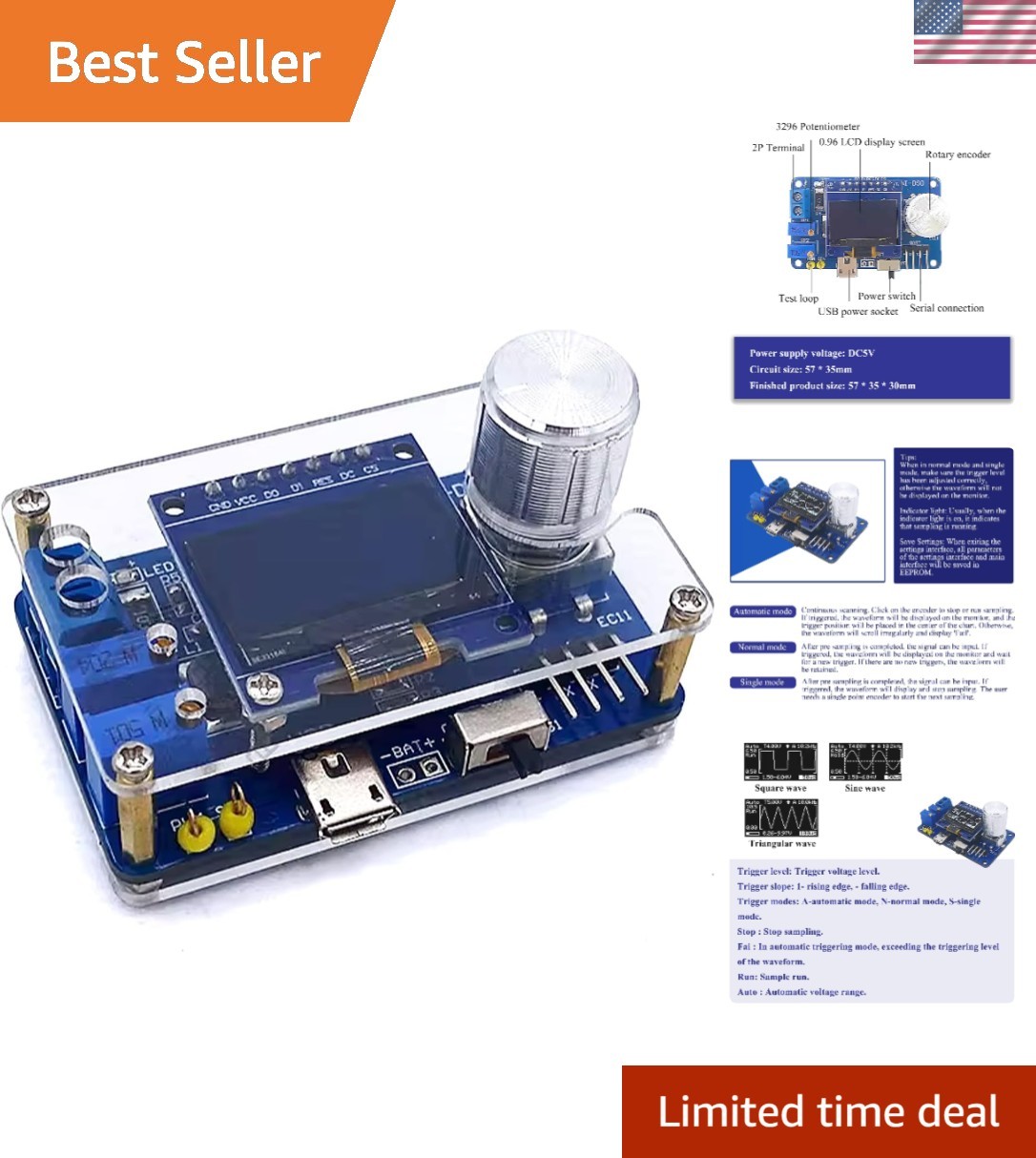

Photos from current listings. Actual item, color, and included accessories may vary.
Beginner Oscilloscope Buying Guide
A beginner oscilloscope is a diagnostic instrument for visualizing voltage over time, and the key trade-off is bandwidth versus sample rate and front-end quality: cheap kits often pair a high nominal sample rate with a low-grade ADC, while established entry models deliver honest specs. The decision rule is simple: buy a scope whose analog bandwidth and sample rate are at least 2–4× the fastest signal you intend to measure, and skip any unit that advertises bandwidth without a matching real-time sample rate.
Median $24.74
Key takeaways
- Entry scopes cluster into three architectures: pocket DSOs (1–2 analog channels, 5–50 MHz, battery powered), USB PC scopes (2 channels, 50–200 MHz, relies on host software), and benchtop DSOs (2–4 channels, 50–200 MHz, integrated display and controls).
- Bandwidth must be paired with real-time sample rate: a 100 MHz scope needs ≥1 GSa/s, and a 50 MHz scope needs ≥500 MSa/s; kits advertising 200 MSa/s at 100 MHz are interpolating and will alias fast edges.
- Vertical resolution is 8-bit on nearly all beginner scopes; 12-bit models exist at higher tiers and matter only for small-signal or power-rail work, not for general hobby debugging.
At a glance
- Category
- Oscilloscopes, Signal & Spectrum Analyzers
- Last updated
- Nov 28, 2026
Current offers
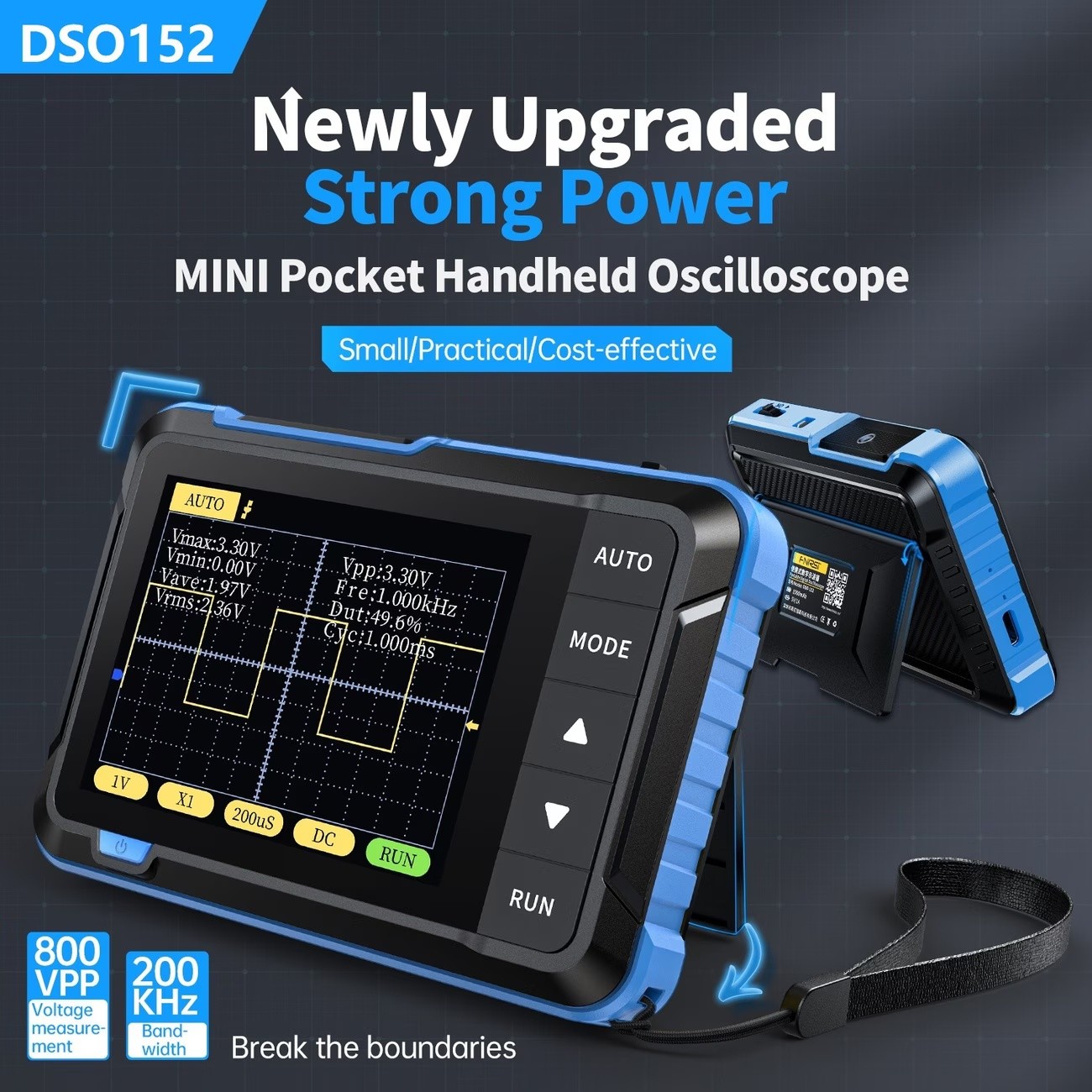
Highlights
- Entry scopes cluster into three architectures: pocket DSOs (1–2 analog channels, 5–50 MHz, battery powered), USB PC scopes (2 channels, 50–200 MHz, relies on host software), and benchtop DSOs (2–4 channels, 50–200 MHz, integrated display and controls).
- Bandwidth must be paired with real-time sample rate: a 100 MHz scope needs ≥1 GSa/s, and a 50 MHz scope needs ≥500 MSa/s; kits advertising 200 MSa/s at 100 MHz are interpolating and will alias fast edges.
- Vertical resolution is 8-bit on nearly all beginner scopes; 12-bit models exist at higher tiers and matter only for small-signal or power-rail work, not for general hobby debugging.
- Probe quality and input impedance (1 MΩ // ~15–20 pF) determine usable bandwidth more than the scope's badge: a 100 MHz scope with a 1× switchable probe is limited to ~6–10 MHz unless you use the 10× position.
Best use cases
- Best fit for audio, Arduino/microcontroller, and low-frequency power work (≤10 MHz): a 50–100 MHz, 2-channel benchtop or USB scope with 1 GSa/s is plenty; skip 200 MHz+ models and pocket DSOs with <20 MHz bandwidth.
- Best fit for field repair and teaching where portability matters: a battery-powered pocket DSO with 1–2 channels and ≥50 MSa/s suits mains-frequency and sensor signals; skip it for switching-power-supply ripple or fast digital buses.
- Best fit for learning on a tight bench: a 2-channel benchtop with built-in function generator and protocol decode gives the most structured path; wrong fit is a single-channel kit with no triggering controls, which teaches bad habits.
- Wrong fit for anyone measuring signals above 25 MHz: pocket DSOs and low-end USB scopes; choose a 100 MHz+ benchtop with 1 GSa/s and 10× probes instead.
Buying tips
- Use the 5× rule for digital: to see a clean square wave, scope bandwidth should be ≥5× the clock frequency; a 20 MHz signal needs ~100 MHz bandwidth for faithful edges.
- Demand real-time sample rate, not equivalent-time: require ≥10 samples per period of the fastest signal; 1 GSa/s gives 100 points at 10 MHz, which is marginal for rise-time work.
- Insist on at least 2 channels: single-channel scopes cannot compare input vs output or trigger on one signal while viewing another, which is the core of most debugging.
- Check probe compensation and included accessories: a scope without a 10× probe and a calibration output is incomplete for beginners; 10× probes are mandatory above ~10 MHz.
Specs
| Bandwidth | 20–200 MHz entry tier |
|---|---|
| Sample Rate | ≥10× bandwidth, real-time |
| Channels | 2 analog minimum |
| Form Factor | Benchtop / USB / pocket DSO |
Related searches
What to check before buying
- Bench footprint: benchtop DSOs typically need ~30 × 15 cm of desk depth plus clearance for BNC cables; pocket DSOs fit in a hand but have tiny screens.
- Power: confirm the unit runs on your local mains voltage (100–240 V) or uses USB/battery power; pocket DSOs with Li-ion cells need the correct charger.
- Signal environment: know your maximum frequency and amplitude before choosing bandwidth and input range; 1× probes limit you to ~6 MHz and low voltage.
- Companion parts: budget for a 10× probe per channel, a signal generator or known reference, and BNC cables; a scope alone cannot calibrate or stimulate a circuit.
FAQ
Data sources: eBay / Amazon listings and product attribute feeds. Updated Nov 28, 2026.
Some links on this page are affiliate links. If you buy after clicking one, we may earn a commission at no extra cost to you. This does not change which products appear here or their order. Affiliate disclosure.