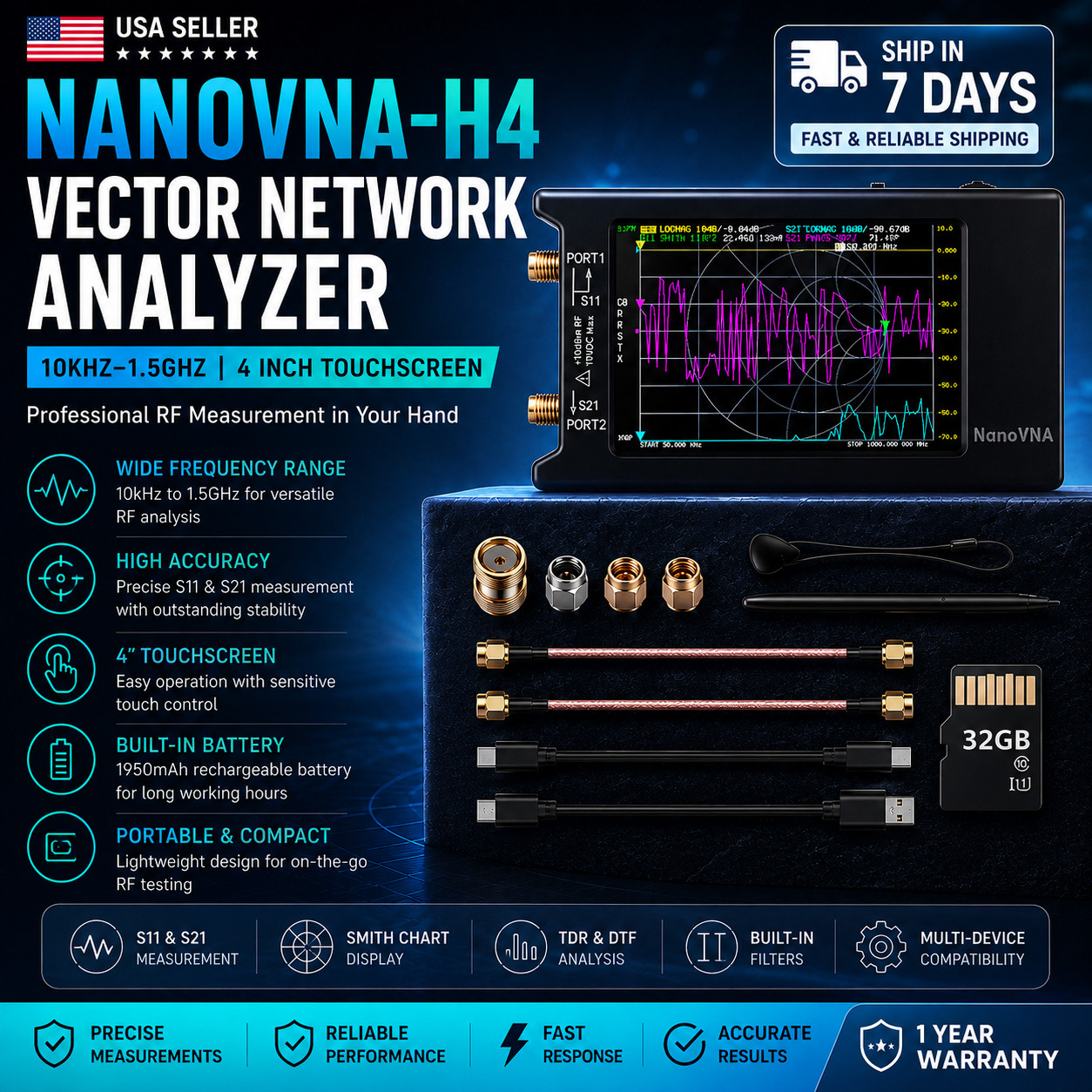

Photos from current listings. Actual item, color, and included accessories may vary.
Portable Rf Spectrum Analyzer Buying Guide
A portable RF spectrum analyzer is a battery-powered, handheld instrument that visualizes signal amplitude across a frequency range, used for field interference hunting, antenna tuning, and transmitter compliance. The core trade-off is between frequency coverage and resolution bandwidth (RBW) versus sweep speed, battery life, and ruggedness—cheap units often fake RBW or lack true tracking generators. The clear decision rule: buy a model with a published RBW ≤ 10 kHz, a real tracking generator for antenna work, and a rated IP or drop spec if used outdoors; skip any unit that lists only 'frequency range' without RBW or DANL.
Key takeaways
- A built-in tracking generator (TG) is essential for antenna/VSWR sweeps; without it you need an external signal generator, doubling cost and cabling.
- Displayed average noise level (DANL) of -150 dBm/Hz or lower separates lab-grade front ends from hobby receivers that mask weak signals.
- Battery runtime of 4–8 hours and USB-C charging distinguish true field portables from benchtop units with a handle; IP54 or MIL-STD drop ratings matter for outdoor use.
At a glance
- Category
- Oscilloscopes, Signal & Spectrum Analyzers
- Last updated
- Nov 28, 2026
Current offers
Highlights
- A built-in tracking generator (TG) is essential for antenna/VSWR sweeps; without it you need an external signal generator, doubling cost and cabling.
- Displayed average noise level (DANL) of -150 dBm/Hz or lower separates lab-grade front ends from hobby receivers that mask weak signals.
- Battery runtime of 4–8 hours and USB-C charging distinguish true field portables from benchtop units with a handle; IP54 or MIL-STD drop ratings matter for outdoor use.
Best use cases
- Best fit: RF field technicians hunting interference or verifying antenna VSWR—pick a 9 kHz–3 GHz handheld with TG and ≥4 hr battery; skip benchtop units with no TG.
- Best fit: Ham radio operators tuning filters and duplexers—choose 100 kHz–1 GHz coverage with 10 kHz RBW and a tracking generator; skip wideband 6 GHz units that sacrifice RBW.
- Wrong fit: Lab bench characterization requiring 1 Hz RBW and phase noise—use a benchtop analyzer; portable units trade RBW for size and battery.
- Wrong fit: Wi-Fi/Bluetooth protocol decoding—pick a vector signal analyzer or a spectrum analyzer with demodulation options; basic portable spectrum analyzers show power only.
Buying tips
- Match frequency coverage to your signals: 1 GHz covers ham/ISM bands; 3 GHz adds Wi-Fi 2.4/5 GHz and cellular; 6 GHz covers 5G and Wi-Fi 6E—don't pay for 6 GHz if you work below 1 GHz.
- Require a published RBW spec; if the datasheet lists only '20 kHz fixed' or omits RBW, treat it as a power meter, not an analyzer.
- For antenna work, confirm a tracking generator with output level ≥ -20 dBm and a return-loss bridge; without TG you cannot measure VSWR directly.
- Check DANL and attenuator range: -150 dBm/Hz DANL and 0–30 dB input attenuation handle strong nearby transmitters without overload.
Specs
| Frequency Coverage | 9 kHz–3 GHz / 6 GHz options |
|---|---|
| Resolution Bandwidth | 1 Hz–10 kHz vs fixed 100 kHz+ |
| Tracking Generator | Built-in TG vs external required |
| DANL | -150 dBm/Hz or lower (good) |
Related searches
What to check before buying
- Measure your antenna feedline and connector type (SMA, N, BNC); ensure the analyzer's input matches or budget for adapters, and verify max input power (typically +20 dBm).
- Confirm battery runtime and charging standard (USB-C PD preferred) for your typical field session; carry a power bank rated for the analyzer's voltage.
- Check environmental rating: IP54 or higher for dusty/rainy outdoor use; a hard carry case and rubber bumpers for drop protection.
- Verify PC connectivity (USB or Wi-Fi) and software support for saving sweeps and comparing traces; older units may require Windows-only software.
FAQ
Data sources: eBay / Amazon listings and product attribute feeds. Updated Nov 28, 2026.
Some links on this page are affiliate links. If you buy after clicking one, we may earn a commission at no extra cost to you. This does not change which products appear here or their order. Affiliate disclosure.