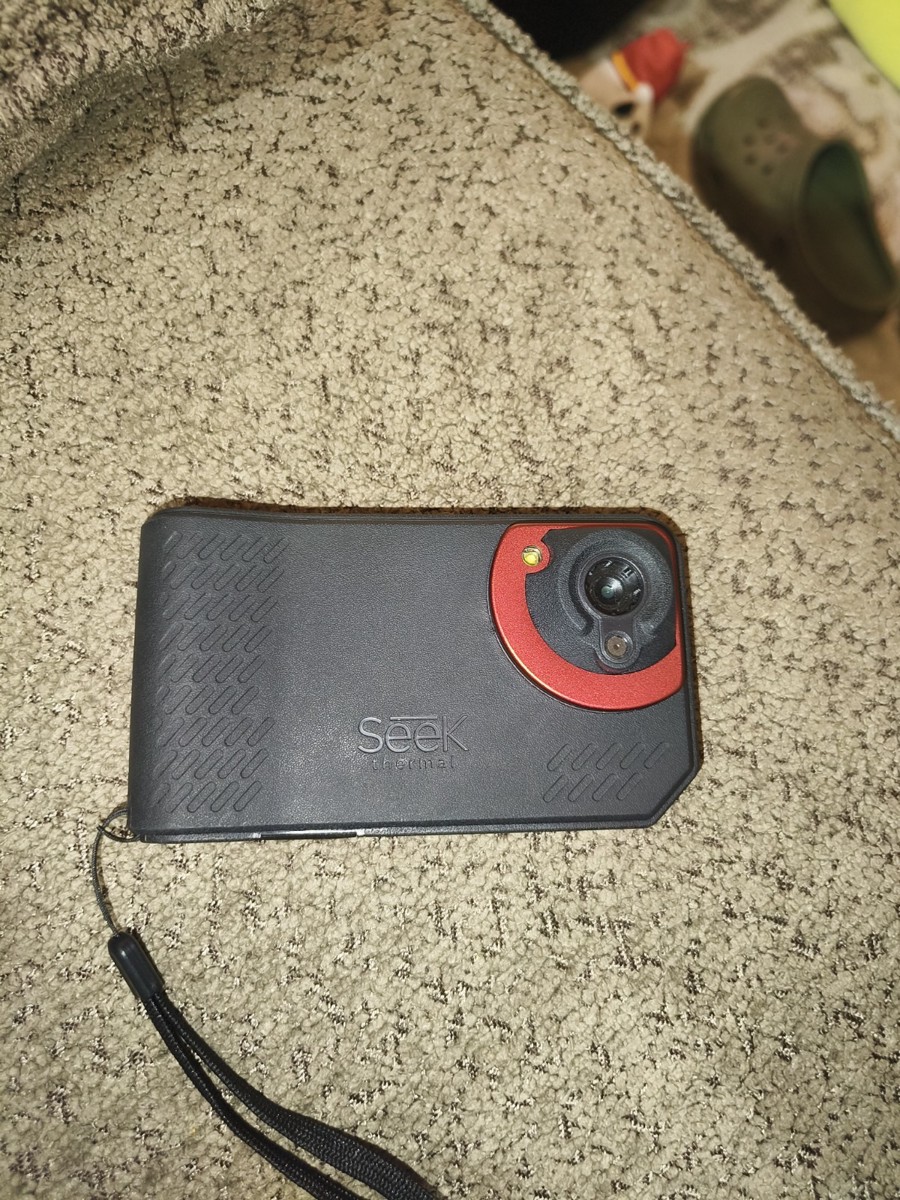

Photos from current listings. Actual item, color, and included accessories may vary.
Seek Thermal Compact Buying Guide
The Seek Thermal Compact is a smartphone-attached thermal camera module that turns an iOS or Android device into a basic thermal imager for diagnostics, inspection, and outdoor use. The primary trade-off is resolution and thermal sensitivity versus price: the standard Compact uses a 206x156 microbolometer with 20° field of view, while the CompactXR extends range with a narrower 8° lens and the CompactPro adds a higher-resolution 320x240 sensor and wider 32° lens. The decision rule is simple: buy the standard Compact for close-range general inspection, the XR for distant targets, and the Pro only when you need finer detail and wider coverage; skip any model if you need radiometric temperature measurement or onboard recording.
Key takeaways
- Sensor tiers: Compact 206x156, CompactXR 206x156 with 8° FOV, CompactPro 320x240 with 32° FOV — resolution and lens choice directly set detectability and framing.
- Thermal sensitivity: all Compact-series modules are rated at ≤0.1°C (100 mK) NETD, enough for spotting insulation gaps, overheating connectors, and moisture trails but not for precision thermography.
- Interface: micro-USB (Android) or Lightning (iOS) connector, bus-powered from the phone — no internal battery, so phone charge and connector type are the limiting factors.
At a glance
- Category
- Thermal Cameras, Borescopes & Visual Inspection
- Last updated
- Nov 28, 2026
Current offers
Highlights
- Sensor tiers: Compact 206x156, CompactXR 206x156 with 8° FOV, CompactPro 320x240 with 32° FOV — resolution and lens choice directly set detectability and framing.
- Thermal sensitivity: all Compact-series modules are rated at ≤0.1°C (100 mK) NETD, enough for spotting insulation gaps, overheating connectors, and moisture trails but not for precision thermography.
- Interface: micro-USB (Android) or Lightning (iOS) connector, bus-powered from the phone — no internal battery, so phone charge and connector type are the limiting factors.
- Frame rate: 8.7 Hz for all Compact models, which avoids export-control restrictions but makes it unsuitable for fast-moving machinery or high-speed thermal events.
Best use cases
- Best fit — home energy audit on a budget: pick the standard Compact (20° FOV) to scan walls, ceilings, and window frames at 2–4 m; do not pick the XR for indoor room scanning because the 8° lens is too narrow.
- Best fit — electrical panel and HVAC diagnostics: pick the CompactPro for its 320x240 resolution and 32° lens so you can frame a full breaker panel at 1–1.5 m and still resolve individual breakers; skip the base Compact if you need to read small component temperatures.
- Best fit — building envelope from a distance or roof inspection: pick the CompactXR for its 8° lens, which doubles effective range; skip it for desktop PCB work because the narrow FOV forces you too far back.
- Wrong fit — any model if you need calibrated temperature readings in reports: the Compact series is non-radiometric (no per-pixel temperature data in saved images); choose a radiometric camera or a Seek Reveal/Fast Frame model instead.
Buying tips
- Match connector to phone: Lightning models work only with Apple devices, micro-USB models only with Android — there is no USB-C variant in the Compact line, so USB-C phones require an adapter or a different model.
- Choose FOV by working distance: 20° (standard) is right for 1–4 m indoor inspection; 8° (XR) suits 5–20 m targets; 32° (Pro) suits 0.5–2 m wide scenes like panels and engines.
- Resolution rule: 206x156 gives about 32,000 pixels — enough to see a hot spot but not its shape; 320x240 (Pro) gives 76,800 pixels, the minimum for reading component-level detail.
- Budget for phone power: the module draws from the phone bus, so a 30-minute scan can consume 10–15% of phone battery; carry a power bank for long inspections.
Specs
| Sensor Resolution | 206x156 (Compact/XR) / 320x240 (Pro) |
|---|---|
| Field of View | 8° (XR) / 20° (Compact) / 32° (Pro) |
| Thermal Sensitivity | ≤0.1°C NETD (all models) |
| Phone Connector | Lightning (iOS) / micro-USB (Android) |
Related searches
What to check before buying
- Confirm your phone’s connector (Lightning or micro-USB) and that the phone supports USB host/OTG — required for the Seek app to recognize the module.
- Measure typical target distance and width: divide target width by distance to estimate required FOV; choose 8°, 20°, or 32° accordingly.
- Check that the Seek Thermal app is available for your OS version and that your phone case is thin enough for the module to seat fully in the port.
- Decide whether you need saved thermal images with temperature data (radiometric) — if yes, the Compact series is the wrong tier.
FAQ
Data sources: eBay / Amazon listings and product attribute feeds. Updated Nov 28, 2026.
Some links on this page are affiliate links. If you buy after clicking one, we may earn a commission at no extra cost to you. This does not change which products appear here or their order. Affiliate disclosure.