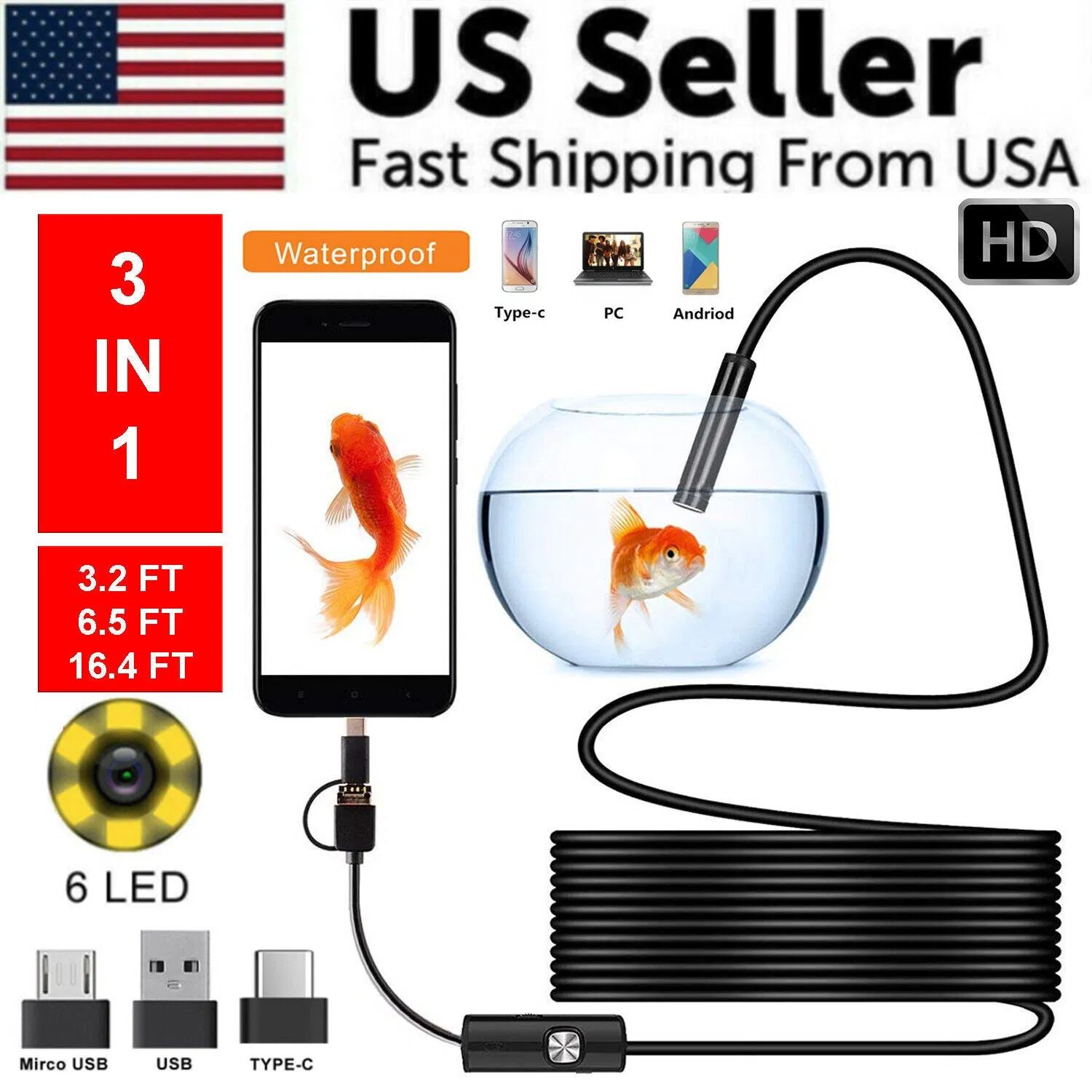

Photos from current listings. Actual item, color, and included accessories may vary.
USB Inspection Camera Buying Guide
USB inspection cameras are cabled or wireless cameras that plug into a phone, tablet, or laptop to inspect drains, engine cylinders, wall cavities, and other hidden spaces. The core trade-off is lens/light quality and cable durability versus connector compatibility (USB-C, Lightning, USB-A) and waterproofing depth. Buy a camera with a 5.5–8mm lens, IP67+ rating, and metal-bodied connector for real work; skip thin 5mm unsealed units with plastic plugs for anything beyond occasional hobby use.
Key takeaways
- Lens diameter drives access: 5.5mm probes fit most spark plug holes and 1/2-inch pipe bends, while 8mm units give brighter images but block tight HVAC and conduit turns.
- Light output matters more than resolution: 6–8 adjustable white LEDs with a dimmer wheel prevent bloom on close-up metal and plastic surfaces; fixed LEDs wash out at 1–2 inches.
- Cable construction separates durable from disposable: metal-braided or fiberglass-reinforced cable resists kinking and oil exposure, while thin PVC jackets fail at the strain relief within months.
At a glance
- Category
- Thermal Cameras, Borescopes & Visual Inspection
- Last updated
- Nov 28, 2026
Current offers
Highlights
- Lens diameter drives access: 5.5mm probes fit most spark plug holes and 1/2-inch pipe bends, while 8mm units give brighter images but block tight HVAC and conduit turns.
- Light output matters more than resolution: 6–8 adjustable white LEDs with a dimmer wheel prevent bloom on close-up metal and plastic surfaces; fixed LEDs wash out at 1–2 inches.
- Cable construction separates durable from disposable: metal-braided or fiberglass-reinforced cable resists kinking and oil exposure, while thin PVC jackets fail at the strain relief within months.
- Connector standard determines device support: USB-C with OTG works on modern Android and iPad, Lightning requires a certified adapter, and USB-A suits laptops; Micro-USB is effectively obsolete on new phones.
Best use cases
- Best fit: 5.5mm IP67 USB-C endoscope for automotive cylinder and drain inspection—choose a 3–5m cable with dimmable LEDs and a side-view mirror clip.
- Best fit: 8mm 1080p USB-A borescope for laptop-based HVAC and wall-cavity work—prioritize a rigid cable and a 1m minimum focal range for wider room shots.
- Wrong fit: sub-5mm WiFi units for engine work—WiFi latency and battery dependence make real-time articulation unreliable; use a wired USB-C unit instead.
- Skip: plastic-bodied Micro-USB models for outdoor or wet use—the connector corrodes and the strain relief splits; step up to metal-shell USB-C or Lightning.
Buying tips
- Match cable length to the job: 1–2m for engine bays and under-sink traps, 5m for wall cavities and duct runs, 10m only for outdoor drains where signal loss is acceptable.
- Verify focus range: fixed-focus lenses typically focus from 3–10cm; for wall inspection choose a unit rated to 5cm or closer, not a long-range 15cm lens.
- Check waterproof rating: IP67 handles splashes and brief submersion to 1m; IP68 is required for continuous drain or tank inspection beyond 1m depth.
- Confirm OTG or UVC support: Android needs OTG enabled and a UVC-compatible app; iPhone requires a Lightning-to-USB adapter and a certified app; laptops use UVC natively.
Specs
| Lens Diameter | 5.5mm / 8mm / 3.9mm |
|---|---|
| Waterproof Rating | IP67 vs IP68 |
| Connector Type | USB-C / Lightning / USB-A |
| Cable Length | 1m / 3m / 5m / 10m |
Related searches
What to check before buying
- Measure the narrowest opening you must pass—spark plug hole (~14mm), 1/2-inch pipe (~12mm), or wall cavity (~25mm)—and pick a lens at least 2mm smaller than the tightest bend.
- Confirm your phone or tablet supports USB OTG or UVC; older Android models and some iPads need a powered adapter to run the camera.
- Check the cable jacket material against your environment: oil and fuel require TPU or fiberglass, while drywall dust tolerates PVC but not repeated bending.
- Verify the plug type matches your device without an adapter: USB-C for modern Android/iPad, Lightning for iPhone, USB-A for laptops; adapters add bulk and failure points.
FAQ
Data sources: eBay / Amazon listings and product attribute feeds. Updated Nov 28, 2026.
Some links on this page are affiliate links. If you buy after clicking one, we may earn a commission at no extra cost to you. This does not change which products appear here or their order. Affiliate disclosure.