Need to know whether a wire, outlet, or extension cord is live before you touch it? That's the moment an electrical tester earns its place in your toolbox. The harder part is choosing between a non-contact voltage pen and a clamp multimeter. Both work with AC circuits, but they answer different questions. This head-to-head compares the Digital Multimeter Tester with the Electricity Test Pen, so you can match the tool to the task.
Quick verdict: If your main worry is whether a circuit is live before you touch it, the $3.20 Electricity Test Pen gives you that answer for very little money. If you also need to do more than confirm voltage is present, the $13.87 Digital Multimeter Tester is worth the $10.67 price gap.
At a glance
| Digital Multimeter Tester | Electricity Test Pen | |
|---|---|---|
| Listed price | USD 13.87 | USD 3.20 |
| Best for | Measuring volts, ohms, amps, and AC current through the clamp | Quick non-contact AC live-wire checks |
| Display | Digital LCD | Glowing tip and beeper |
| Test range | AC/DC voltage, resistance, amp readings | 90-1000V AC, 50-500Hz |
| Helpful extras | Data hold, max reading, auto shutdown | CAT II 1000V safety rating |
Where each product wins
The Digital Multimeter Tester wins when you need numbers. The pen's job is to signal whether voltage is present; the multimeter's job is to give you readings you can use to diagnose a circuit. That makes it the stronger choice for troubleshooting, not just confirming a wire is live.
The Electricity Test Pen wins when you need a fast, simple live/dead check. Its touch-tip design makes it an easy first grab when you want to confirm whether a socket or supply cord is energized. Place the tip on a terminal strip, outlet, or power cord, and the pen tells you when voltage is there. For simple live/dead checks around the house, that's often all you need.
Product notes
Digital Multimeter Tester (AC/DC Volt, Ohm, Amp, Clamp Meter)
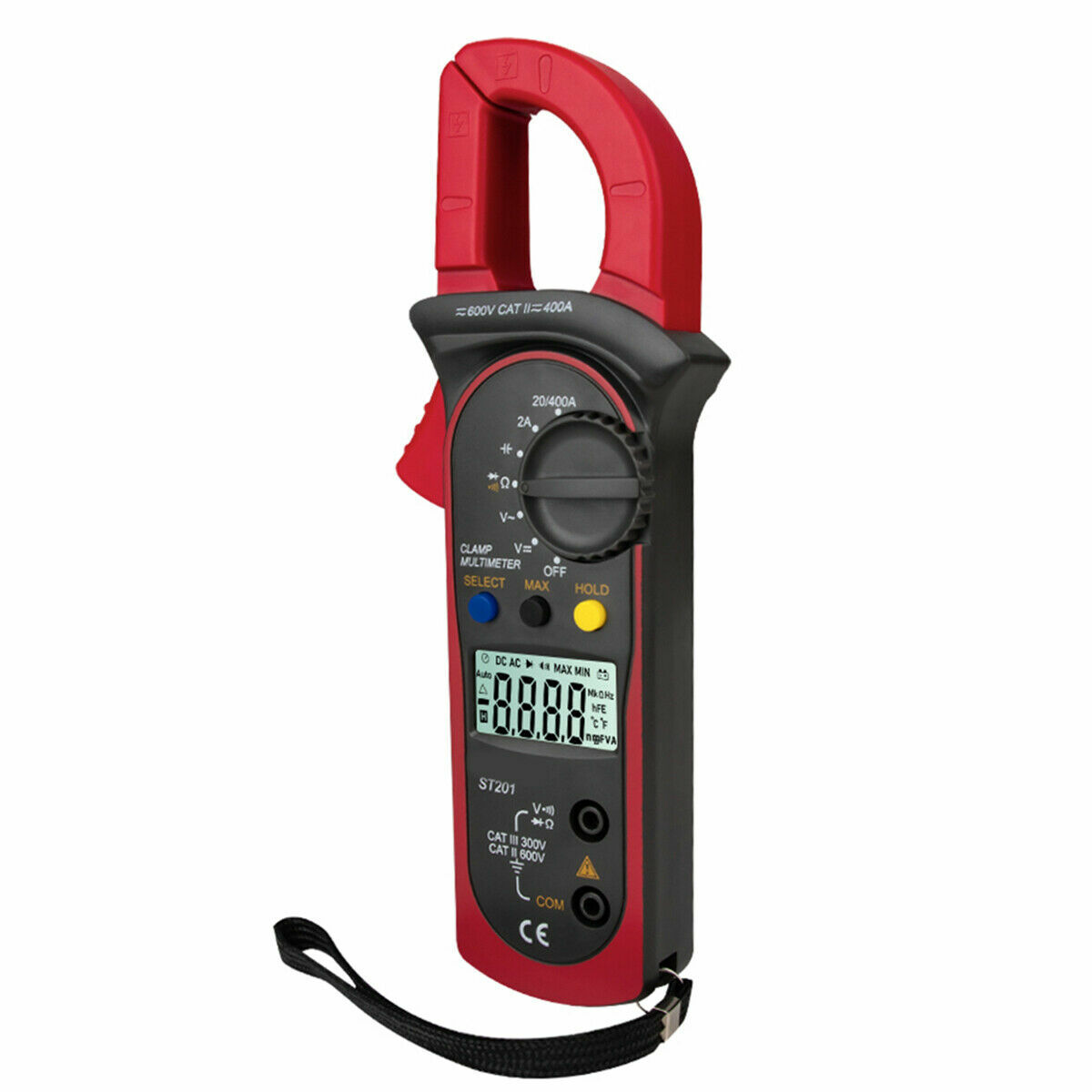
This is the more complete diagnostic tool of the two. The auto-ranging function removes the guesswork of selecting the correct range, and the clamp opens around a conductor up to 26mm, so you can check AC current in a live wire without disconnecting it. The large digital LCD keeps the reading easy to see. Data hold and max reading are handy when the number moves around, and the 15-minute auto shutdown helps save battery. The catch is that it needs two AAA batteries that are not included, so you'll want to have them on hand before you rely on it. For troubleshooting rather than a simple live/dead check, this is the one that gives you the full picture.
Electricity Test Pen (90-1000V AC Non-Contact)

This pen is a straightforward live-circuit detector for AC systems. Touch the tip to an outlet, terminal strip, or supply cord; if it glows red and beeps, the circuit is energized. It detects 90-1000V AC and carries a CAT II 1000V safety rating, so it fits naturally into household and general electrical work. The trade-off is its AC-only detection window: it starts at 90V, so it isn't intended for low-voltage or DC troubleshooting. If all you need is a quick "is it live" answer, this pen is the simpler route.
Final choice by use case
- For a fast live/dead check on outlets, switches, and power cords, choose the Electricity Test Pen.
- For deeper electrical diagnosis and actual readings, choose the Digital Multimeter Tester.
- If you want one tester that can handle both a quick live check and deeper electrical diagnosis, the Digital Multimeter Tester covers more ground.