
Photos from current listings. Actual item, color, and included accessories may vary.
Dual Laser Infrared Thermometer Buying Guide
Dual laser infrared thermometers project two aiming beams that converge at the correct spot size, eliminating the guesswork of single-dot IR guns when measuring small or distant targets. The core trade-off is optical resolution (distance-to-spot ratio) versus emissivity control: fixed-emissivity 12:1 guns suit general surfaces, while adjustable-emissivity 30:1+ models with K-type inputs are required for metals, shiny materials, and industrial diagnostics. Buy the highest distance-to-spot ratio and adjustable emissivity you can afford; skip fixed-emissivity single-laser units for any precision or reflective-target work.
Median $50.99
Key takeaways
- Distance-to-spot (D:S) ratio defines target accuracy: 12:1 reads a 1-inch spot at 12 inches; 30:1 or 50:1 is needed to isolate small components or measure safely from a distance.
- Adjustable emissivity (typically 0.10–1.00) is mandatory for metals and shiny surfaces; fixed 0.95 emissivity only reads non-reflective organics accurately.
- Dual-laser convergence marks the true spot diameter at the focal distance; single-laser units only indicate the center point and mislead at non-focal ranges.
At a glance
- Category
- Industrial Gauges & Meters
- Last updated
- Nov 28, 2026
Current offers
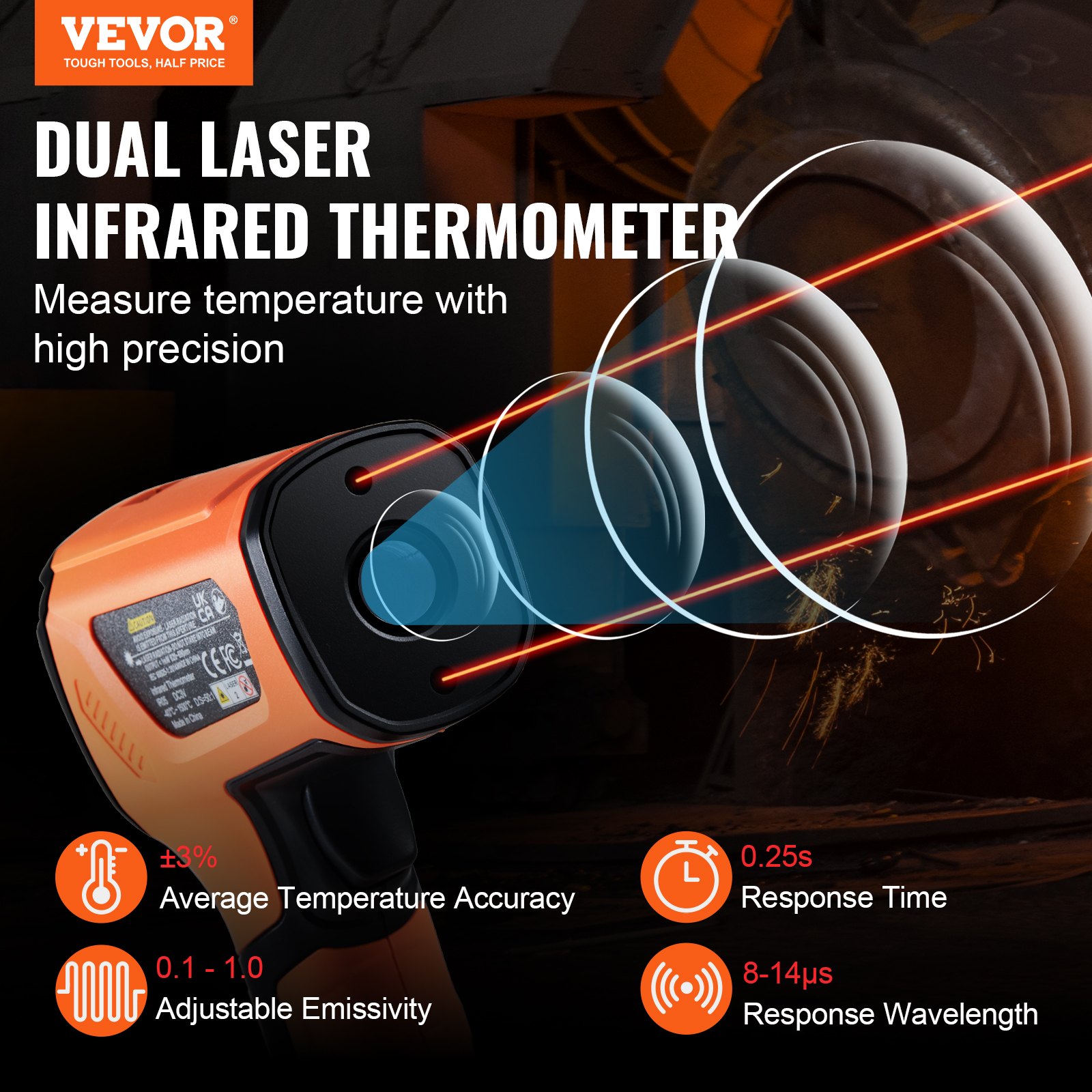 Infrared Thermometer, Dual Laser Temperature Gun Non-Contact, Handheld IR Heat Gun With Adjustable Emissivity$45.99View on Mallflare
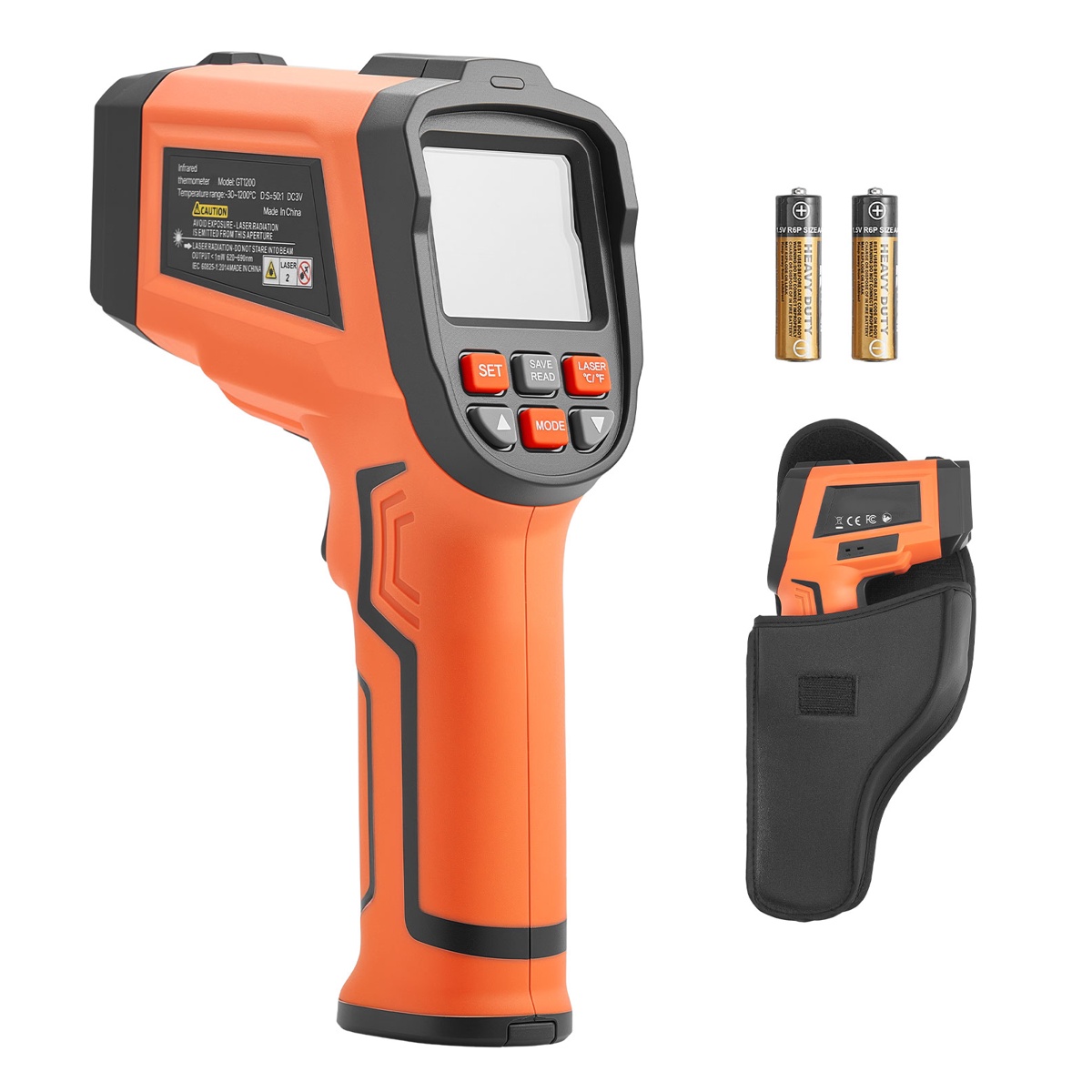 Infrared Thermometer, -22℉ To 2912℉ Dual-Mode IR Gun With K-Type Thermocouple, Dual Laser Heat Temperature Gun Non-Contact For Metal Smelting/Engine/Industry/Cooking (Not For Human)$55.99View on Mallflare
Highlights
- Distance-to-spot (D:S) ratio defines target accuracy: 12:1 reads a 1-inch spot at 12 inches; 30:1 or 50:1 is needed to isolate small components or measure safely from a distance.
- Adjustable emissivity (typically 0.10–1.00) is mandatory for metals and shiny surfaces; fixed 0.95 emissivity only reads non-reflective organics accurately.
- Dual-laser convergence marks the true spot diameter at the focal distance; single-laser units only indicate the center point and mislead at non-focal ranges.
- K-type thermocouple input extends range to contact probes for surfaces IR cannot read (reflective metals, internal liquids) and is a key industrial-tier differentiator.
Best use cases
- Best fit: HVAC and electrical diagnostics — choose 12:1 to 20:1 with adjustable emissivity and a bright dual-laser circle for safe panel and duct readings.
- Best fit: Metal smelting, engine, and industrial process — choose 30:1+ optics, adjustable emissivity down to 0.10, and K-type input; skip fixed-emissivity consumer guns.
- Wrong fit: Human or forehead temperature screening — dedicated clinical thermometers are calibrated for 0.98 emissivity at short range; industrial IR guns are explicitly not for human use.
Buying tips
- Compute the spot size before buying: at 12:1 a 1-inch target requires 12 inches distance; at 30:1 the same target allows 30 inches — pick the ratio to your smallest target.
- Match emissivity range to your materials: 0.95 for food, rubber, and painted surfaces; 0.10–0.30 for bare aluminum, copper, and stainless steel — only adjustable models can read these.
- Verify dual-laser convergence: true dual-laser models show two beams meeting at the spot edge; avoid units marketing two dots that do not bracket the target circle.
- Add a K-type probe only if you need contact measurement; the thermocouple input is the practical dividing line between prosumer and industrial tiers.
Specs
| Optics D:S Ratio | 12:1 general / 30:1+ industrial |
|---|---|
| Emissivity Control | Fixed 0.95 vs adjustable 0.10–1.00 |
| Laser Aiming | Single-dot vs dual converging beams |
| Thermocouple Input | None vs K-type contact probe |
Related searches
What to check before buying
- Measure your smallest target and farthest safe distance, then confirm the D:S ratio keeps the spot smaller than the target.
- Confirm the temperature range covers your process: -22°F to 2912°F spans general use; high-temp models are required above 1000°F for smelting and kilns.
- Check emissivity adjustability and whether a K-type thermocouple port is present for reflective or contact-only surfaces.
- Verify power and environment: 9V or AAA battery type, backlit display for dim spaces, and operating temperature range for outdoor or hot-floor use.
FAQ
Data sources: eBay / Amazon listings and product attribute feeds. Updated Nov 28, 2026.
Some links on this page are affiliate links. If you buy after clicking one, we may earn a commission at no extra cost to you. This does not change which products appear here or their order. Affiliate disclosure.