
Photos from current listings. Actual item, color, and included accessories may vary.
Infrared Cooking Thermometer Buying Guide
Infrared cooking thermometers are non-contact surface-temperature tools that use a thermopile sensor and emissivity calibration to read griddle, oil, pizza-stone, and pan heat without piercing food. The core trade-off is target emissivity accuracy and distance-to-spot ratio versus added probe versatility — cheap units with fixed high emissivity and low D:S ratios misread shiny or distant surfaces. Buy a cooking IR gun only when it specifies adjustable emissivity, a D:S ratio of at least 12:1, and a documented accuracy band; skip anything rated solely for industrial ranges without a food-safe probe.
Median $50.99
Key takeaways
- Spot measurement accuracy depends on distance-to-spot (D:S) ratio — 12:1 means a 1-inch target from 12 inches; below 8:1, grill and pan readings blur with ambient heat.
- Adjustable emissivity (0.10–1.00) is mandatory for cooking: black cast iron near 0.95, polished stainless near 0.30, and aluminum foil near 0.05 read wildly wrong at fixed 0.95.
- Cooking-grade IR guns typically cover -58°F to 1,000°F with ±2°F or ±2% accuracy; extended-range industrial models to 2,912°F sacrifice low-end resolution and food-probe compatibility.
At a glance
- Category
- Industrial Gauges & Meters
- Last updated
- Nov 28, 2026
Current offers
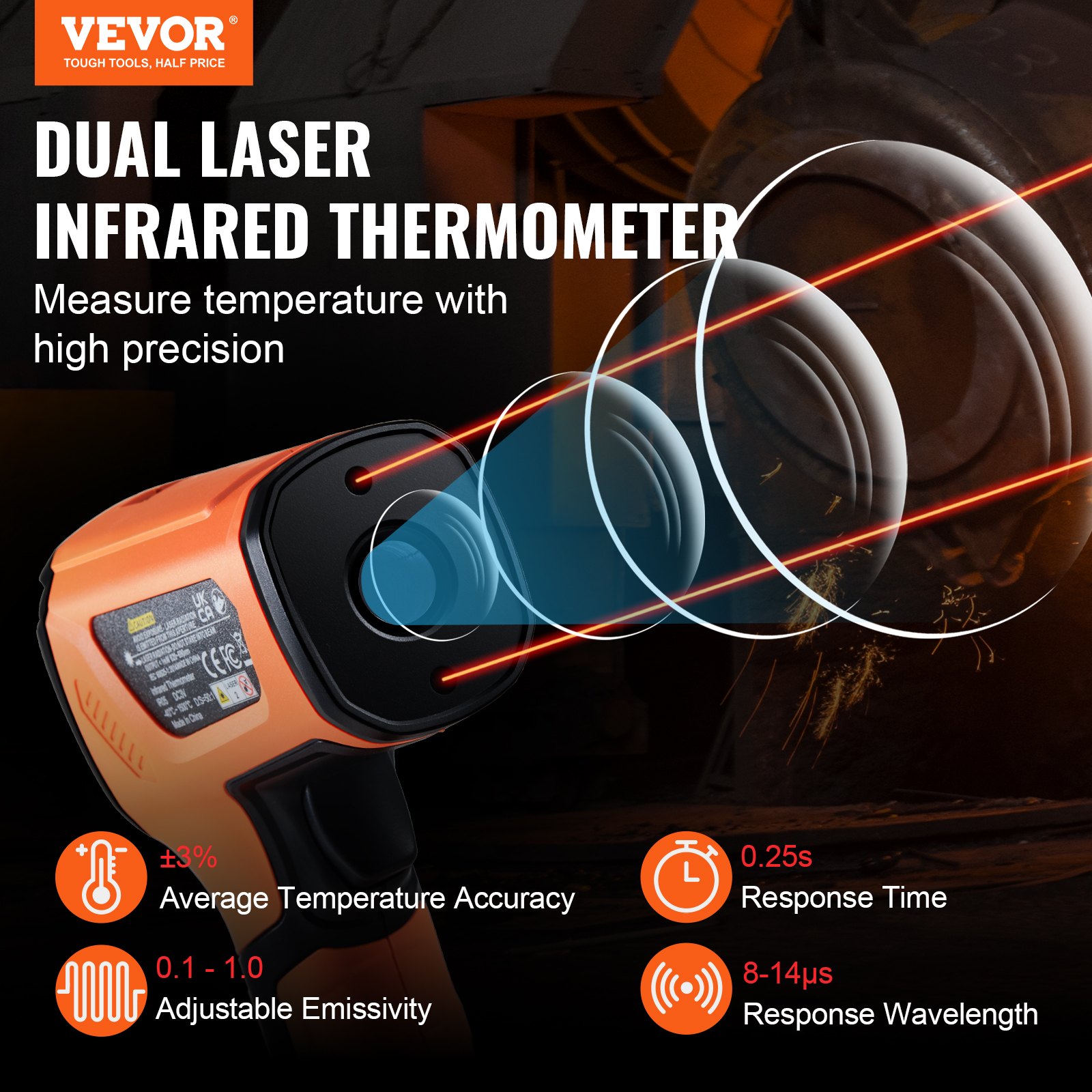 Infrared Thermometer, Dual Laser Temperature Gun Non-Contact, Handheld IR Heat Gun With Adjustable Emissivity$45.99View on Mallflare
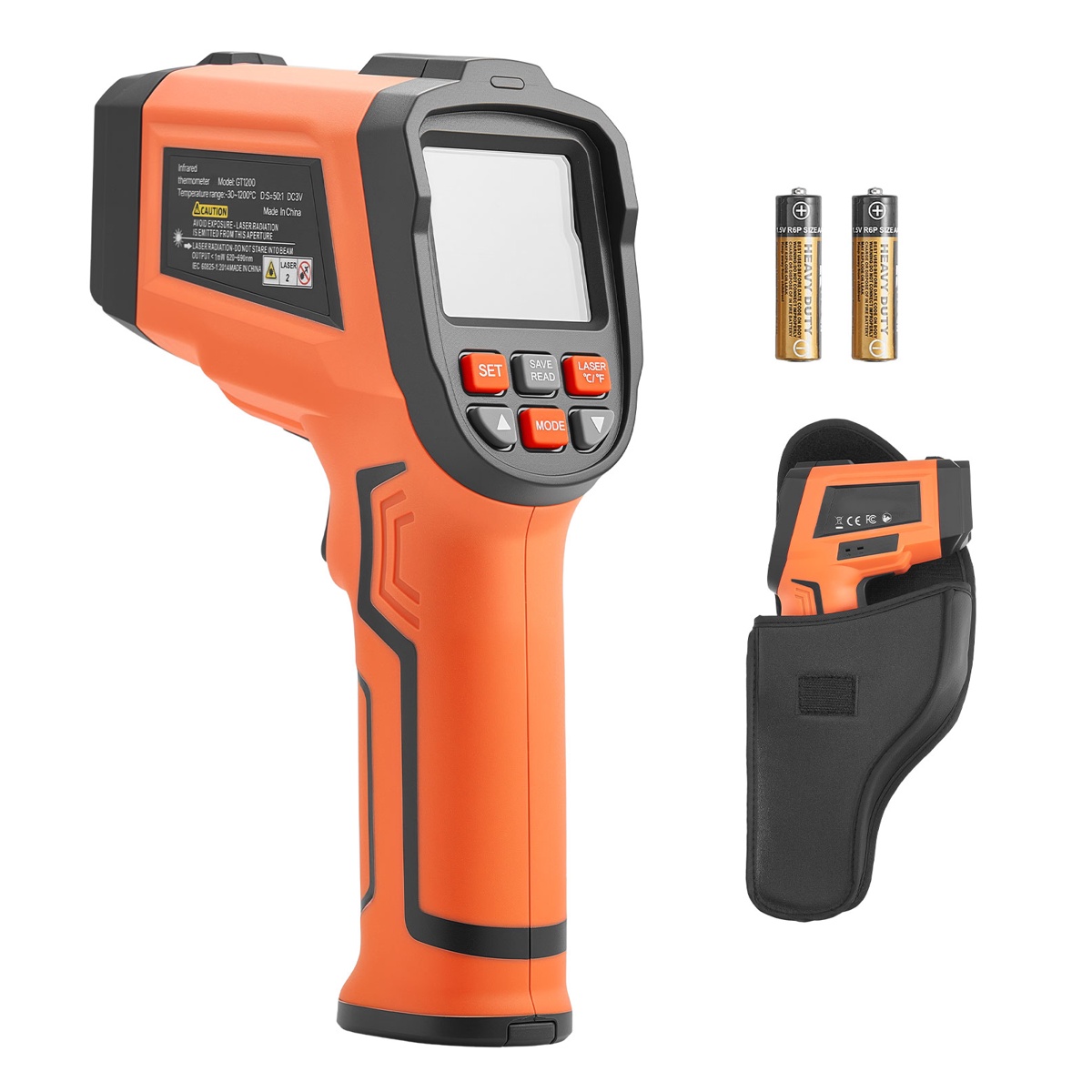 Infrared Thermometer, -22℉ To 2912℉ Dual-Mode IR Gun With K-Type Thermocouple, Dual Laser Heat Temperature Gun Non-Contact For Metal Smelting/Engine/Industry/Cooking (Not For Human)$55.99View on Mallflare
Highlights
- Spot measurement accuracy depends on distance-to-spot (D:S) ratio — 12:1 means a 1-inch target from 12 inches; below 8:1, grill and pan readings blur with ambient heat.
- Adjustable emissivity (0.10–1.00) is mandatory for cooking: black cast iron near 0.95, polished stainless near 0.30, and aluminum foil near 0.05 read wildly wrong at fixed 0.95.
- Cooking-grade IR guns typically cover -58°F to 1,000°F with ±2°F or ±2% accuracy; extended-range industrial models to 2,912°F sacrifice low-end resolution and food-probe compatibility.
- Dual-mode units add a fold-out K-type thermocouple probe (±1°F) for internal meat and oil temps, pairing surface IR with core-probe verification in one tool.
Best use cases
- Best fit: cast-iron searing, griddle, and pizza-steel monitoring — pick a 12:1 or better D:S gun with adjustable emissivity set to 0.95 for seasoned iron.
- Best fit: BBQ and smoker surface checks — a dual-mode IR plus K-type probe lets you scan grate hotspots and probe brisket internal temp in the same tool.
- Wrong fit: shiny stainless pans, foil-wrapped food, or polished grates — low-emissivity surfaces require a contact probe or emissivity set near 0.30; a fixed-0.95 IR gun will read falsely low.
- Wrong fit: human fever screening or clinical use — cooking IR guns are calibrated for surfaces, not body core, and must be skipped for medical temperature checks.
Buying tips
- Compute spot size before buying: at 12:1 D:S, a 1-inch spot needs 12 inches of distance; at 6:1 you must halve that distance or accept a 2-inch averaged reading.
- Match range to task: cooking needs -58°F to 1,000°F with ±2°F repeatability; metal smelting or engine work needs the 2,912°F ceiling but loses low-temp food accuracy.
- Require adjustable emissivity in 0.01 steps and a printed emissivity table — fixed 0.95 units cannot read stainless, copper, or foil accurately.
- Choose a dual-laser unit only if the two beams bracket the true spot circle; single-dot lasers often mislead users into reading outside the measurement cone.
Specs
| D:S Ratio | 8:1 to 50:1 (12:1 cooking min) |
|---|---|
| Emissivity | Adjustable 0.10–1.00, 0.01 steps |
| Temperature Range | -58°F to 1,000°F cooking / 2,912°F industrial |
| Probe Type | IR only vs dual IR + K-type thermocouple |
Related searches
What to check before buying
- Confirm your hottest target: most home cooking tops out near 700°F (pizza steel) or 450°F (frying oil) — a 1,000°F ceiling is sufficient and keeps low-end accuracy tighter.
- Measure your typical working distance from hand to grate or pan; divide by the D:S ratio to get real spot size and ensure it fits inside the food or pan zone.
- Check surface finish of your cookware — seasoned cast iron and black steel read well at 0.95, but stainless and aluminum require adjustable emissivity down to 0.30 or a contact probe.
- Verify battery and display: backlit LCD for dim kitchens or night grilling and a standard AAA or 9V cell avoid proprietary charging docks that fail outdoors.
FAQ
Data sources: eBay / Amazon listings and product attribute feeds. Updated Nov 28, 2026.
Some links on this page are affiliate links. If you buy after clicking one, we may earn a commission at no extra cost to you. This does not change which products appear here or their order. Affiliate disclosure.