
Photos from current listings. Actual item, color, and included accessories may vary.
Infrared Thermometer With Probe Buying Guide
An infrared thermometer with probe combines a non-contact IR sensor for fast surface scans with a contact K-type thermocouple for internal or reflective-target readings. The core trade-off is optical resolution and emissivity adjustment versus probe accuracy and response time—cheap units fix emissivity at 0.95 and ship slow, low-grade probes. Buy a dual-laser unit with adjustable emissivity from 0.10–1.00 and a rated K-type probe; skip fixed-emissivity guns with no probe or unrated thermocouples.
Median $50.99
Key takeaways
- Dual-laser sighting converges at the true spot diameter, while single-laser units only mark the center and mislead at distance.
- Adjustable emissivity from 0.10 to 1.00 is mandatory for metal, glass, and shiny surfaces; fixed 0.95 units misread those targets badly.
- Distance-to-spot ratio (D:S) governs accuracy: 12:1 suits close bench work, 30:1+ is needed for HVAC ducts and electrical panels at range.
At a glance
- Category
- Industrial Gauges & Meters
- Last updated
- Nov 28, 2026
Current offers
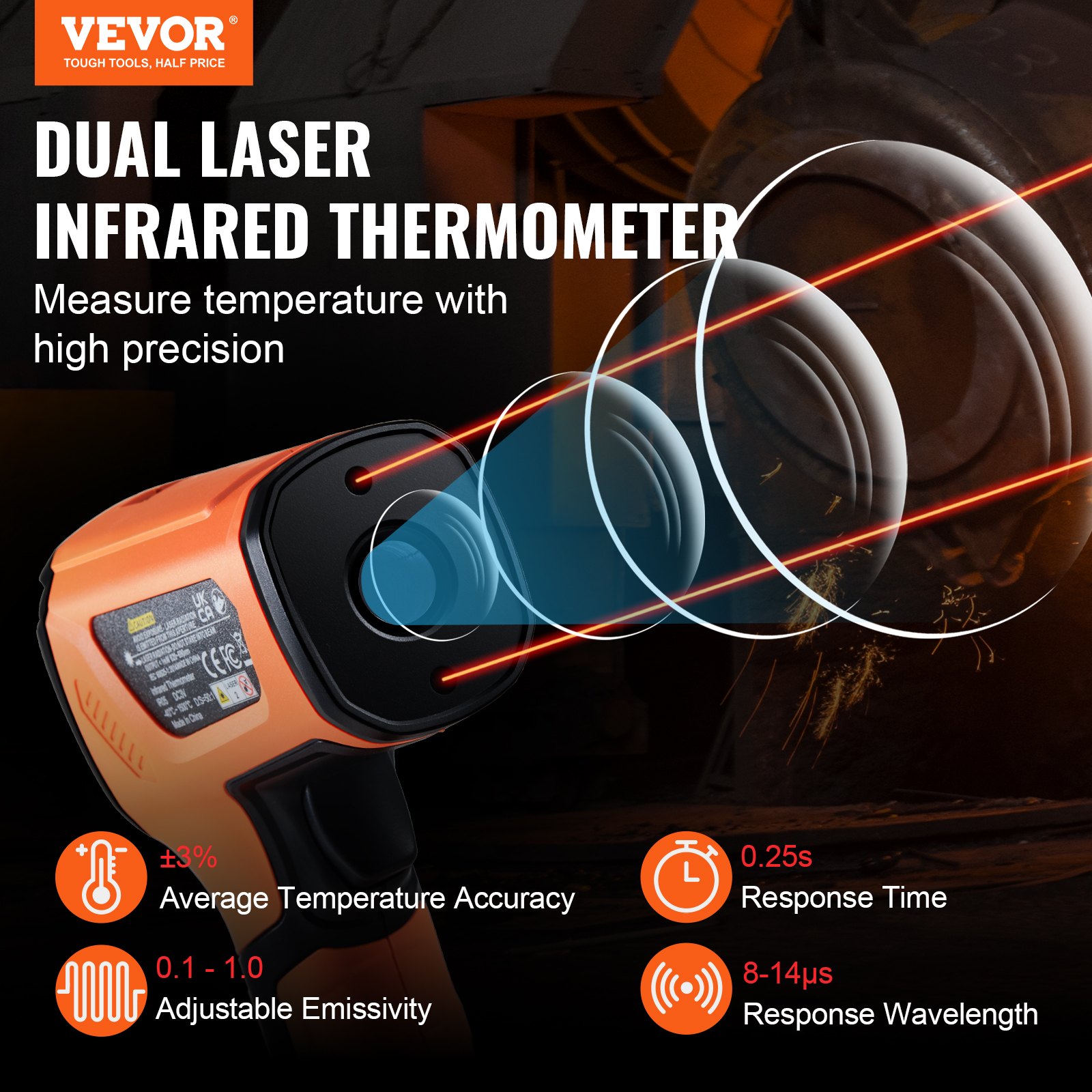 Infrared Thermometer, Dual Laser Temperature Gun Non-Contact, Handheld IR Heat Gun With Adjustable Emissivity$45.99View on Mallflare
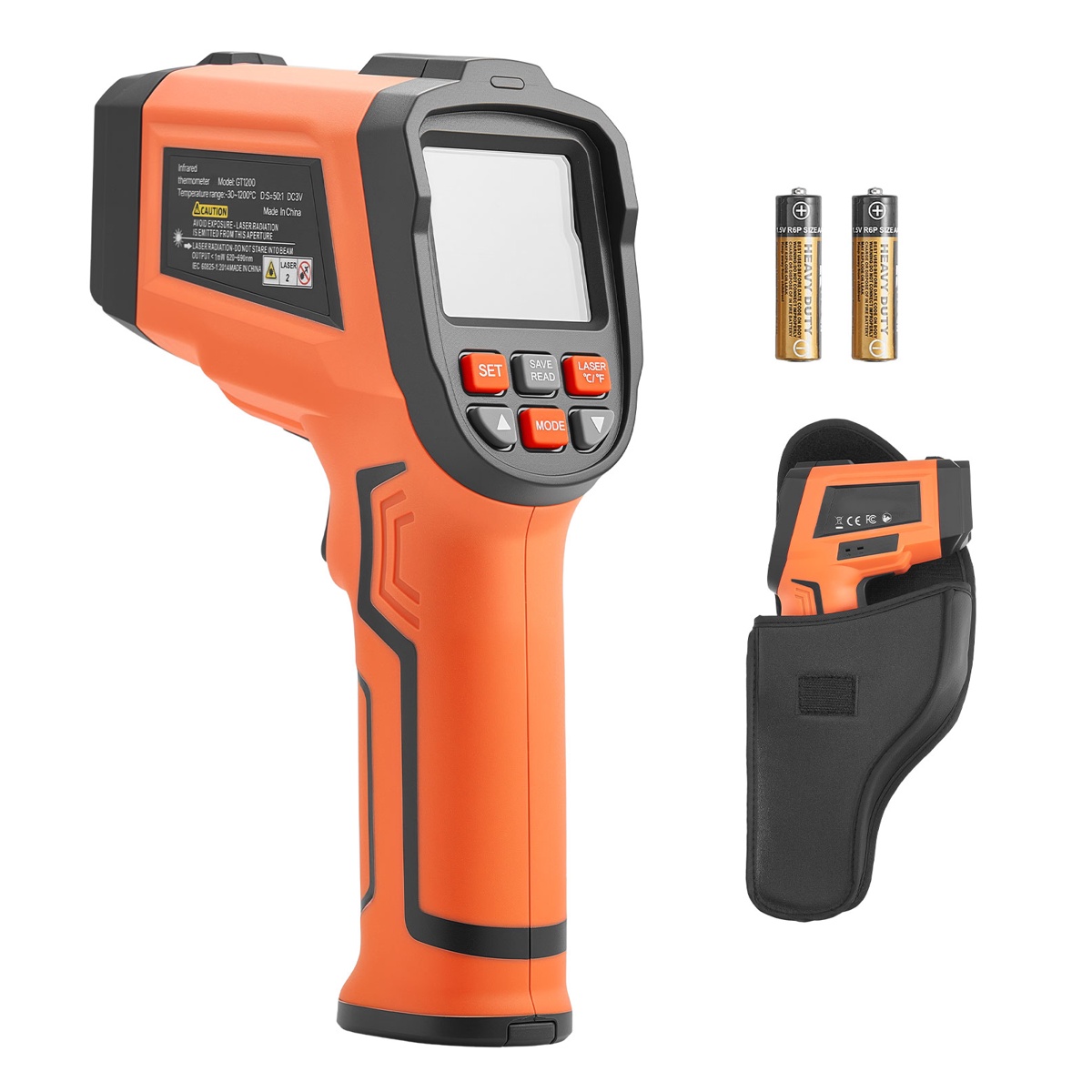 Infrared Thermometer, -22℉ To 2912℉ Dual-Mode IR Gun With K-Type Thermocouple, Dual Laser Heat Temperature Gun Non-Contact For Metal Smelting/Engine/Industry/Cooking (Not For Human)$55.99View on Mallflare
Highlights
- Dual-laser sighting converges at the true spot diameter, while single-laser units only mark the center and mislead at distance.
- Adjustable emissivity from 0.10 to 1.00 is mandatory for metal, glass, and shiny surfaces; fixed 0.95 units misread those targets badly.
- Distance-to-spot ratio (D:S) governs accuracy: 12:1 suits close bench work, 30:1+ is needed for HVAC ducts and electrical panels at range.
- K-type thermocouple probes are rated by max temperature and response time; industrial probes handle 500–1200°C, while cooking probes top out near 300°C.
Best use cases
- Metal smelting, engine blocks, and forge work: pick a high-range IR gun (to ~1600°C/2912°F) with adjustable emissivity plus a rated high-temp K-type probe; skip cooking-grade units.
- HVAC duct, register, and electrical panel checks: choose a 30:1 or better D:S ratio with dual lasers so spot size stays small at distance; a 12:1 gun reads too wide a target.
- Cooking and food safety: use the contact probe for internal meat temps and the IR mode only for surface/pan scans; skip industrial high-range guns with coarse resolution.
- Automotive diagnostics: a mid-range dual-mode gun with a clamp or surface probe covers exhaust, brakes, and coolant; skip fixed-emissivity guns that misread polished metal.
Buying tips
- Calculate spot size: at D:S 12:1 a 25 mm target needs you within 300 mm; at 30:1 the same target is safe at 750 mm—match ratio to your working distance.
- Set emissivity per material: 0.95 for most foods and organics, 0.10–0.30 for polished metals, 0.85–0.95 for glass—only buy guns with full 0.10–1.00 adjustment.
- Match probe type to the meter: confirm the input accepts a standard K-type mini-connector and check the probe's rated max temperature against your process.
- Check response time and spectral range: 500 ms or faster suits moving targets, and short-wavelength sensors (7–18 µm) are required for accurate metal reads.
Specs
| Sighting | Dual laser vs single laser vs none |
|---|---|
| Emissivity | Adjustable 0.10–1.00 vs fixed 0.95 |
| D:S Ratio | 12:1 close work / 30:1+ long range |
| Probe Type | K-type thermocouple, rated max temp |
Related searches
What to check before buying
- Measure your working distance and target size, then confirm the D:S ratio keeps the spot inside the target at that range.
- Verify the probe's rated temperature range and connector type match your application and the meter's input.
- Confirm the emissivity adjustment covers 0.10–1.00 if you will measure metal, glass, or shiny surfaces.
- Check display resolution, backlight, and min/max/hold functions suit dim or fast-moving industrial environments.
FAQ
Data sources: eBay / Amazon listings and product attribute feeds. Updated Nov 28, 2026.
Some links on this page are affiliate links. If you buy after clicking one, we may earn a commission at no extra cost to you. This does not change which products appear here or their order. Affiliate disclosure.