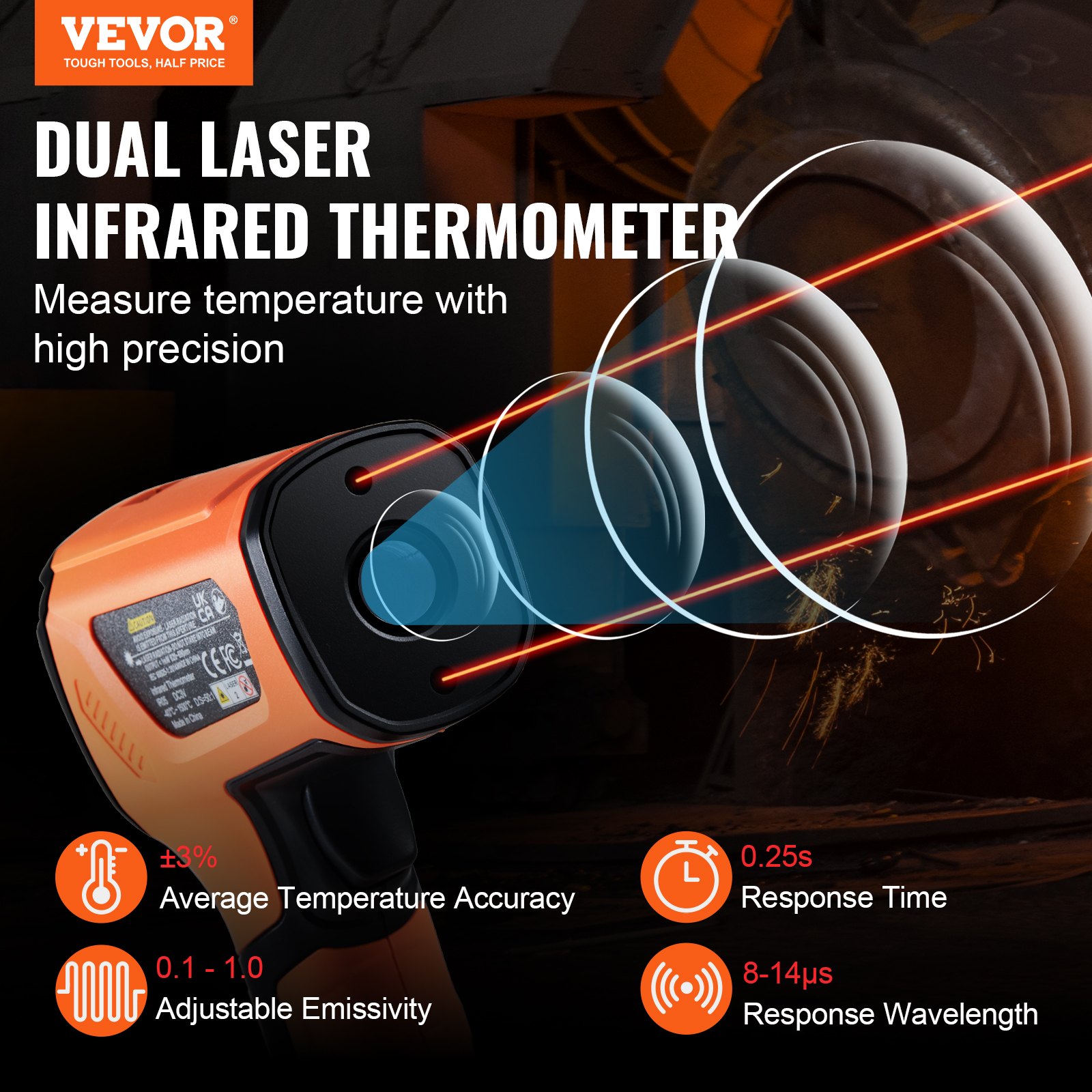

Photos from current listings. Actual item, color, and included accessories may vary.
Laser Cooking Thermometer Buying Guide
A laser cooking thermometer is an infrared thermometer with a laser aiming dot that reads surface temperature without contact—the laser only targets, it does not measure. The core trade-off is emissivity accuracy and spot-size math versus rugged build and probe versatility: fixed-emissivity, wide-ratio spot guns read shiny metal poorly, while adjustable-emissivity and thermocouple-input models handle both pan surfaces and internal food temps. The decision rule is simple: buy adjustable emissivity plus a K-type probe input if you cook on cast iron, stainless, or grill metal; a fixed-emissivity, 12:1 or better spot gun is fine for non-shiny surfaces only.
Key takeaways
- Laser aiming is visual only—measurement comes from the IR sensor's field of view; dual-laser models bracket the true spot circle at a given distance.
- Spot ratio (distance-to-spot) sets accuracy: a 12:1 gun reads a 1-inch circle at 12 inches; 1-inch-diameter pans need sub-1-inch spot geometry.
- Adjustable emissivity (0.1–1.0) is required for bare stainless, aluminum, and cast iron; fixed 0.95 emissivity assumes matte black/organic surfaces.
At a glance
- Category
- Industrial Gauges & Meters
- Last updated
- Nov 28, 2026
Current offers
Highlights
- Laser aiming is visual only—measurement comes from the IR sensor's field of view; dual-laser models bracket the true spot circle at a given distance.
- Spot ratio (distance-to-spot) sets accuracy: a 12:1 gun reads a 1-inch circle at 12 inches; 1-inch-diameter pans need sub-1-inch spot geometry.
- Adjustable emissivity (0.1–1.0) is required for bare stainless, aluminum, and cast iron; fixed 0.95 emissivity assumes matte black/organic surfaces.
- Dual-mode units adding a K-type thermocouple input cover internal meat temps and probe-style readings the IR sensor cannot measure.
Best use cases
- Best fit: cast-iron searing, grill grates, pizza stones, and deep-fry oil—pick an adjustable-emissivity gun with 12:1 or better spot ratio and a K-type probe port.
- Best fit: home kitchen general use on matte surfaces (bread, caramel, chocolate, oil)—a fixed 0.95 emissivity gun with 8:1 spot ratio and ±2% accuracy is sufficient.
- Wrong fit: measuring internal meat doneness without a probe—IR only reads surface; choose a dual-mode K-type thermocouple model or skip IR entirely.
- Wrong fit: shiny bare stainless or polished aluminum pans with a fixed-emissivity gun—readings will be low and erratic; use adjustable emissivity or a probe.
Buying tips
- Apply the spot formula: measured spot diameter = distance ÷ spot ratio. At 6 inches, a 12:1 gun reads 0.5 inches—keep the target larger than that circle.
- Match emissivity to surface: set 0.95 for food/oil/water, about 0.80 for cast iron, 0.10–0.30 for bare shiny metal; fixed-0.95 guns cannot correct this.
- Choose accuracy of ±2% of reading or ±2°F (whichever is greater) and resolution of 0.1°F below 200°F for cooking precision.
- Skip 'laser thermometer' listings that only state laser wavelength without spot ratio, emissivity range, and response time—these are the three specs that determine usable accuracy.
Specs
| Emissivity Setting | Adjustable 0.1–1.0 vs fixed 0.95 |
|---|---|
| Spot Ratio (D:S) | 8:1 to 12:1 cooking; 30:1+ industrial |
| Probe Input | K-type thermocouple vs IR-only |
| Accuracy / Resolution | ±2% or ±2°F; 0.1°F below 200°F |
Related searches
What to check before buying
- Confirm surface type at the cooking zone: matte/organic surfaces accept fixed 0.95 emissivity; bare metal requires adjustable emissivity or a contact probe.
- Measure distance from your hand position to the pan/grill surface—choose a spot ratio that keeps the measurement circle smaller than the target at that distance.
- Check temperature range covers your cooking: fry oil to 450°F, pizza stone to 700°F, grill sear to 900°F; smelting/metalwork needs the 2000°F+ class.
- Verify power and probe compatibility: 9V or AAA battery type, and whether a K-type thermocouple probe is included or sold separately.
FAQ
Data sources: eBay / Amazon listings and product attribute feeds. Updated Nov 28, 2026.
Some links on this page are affiliate links. If you buy after clicking one, we may earn a commission at no extra cost to you. This does not change which products appear here or their order. Affiliate disclosure.