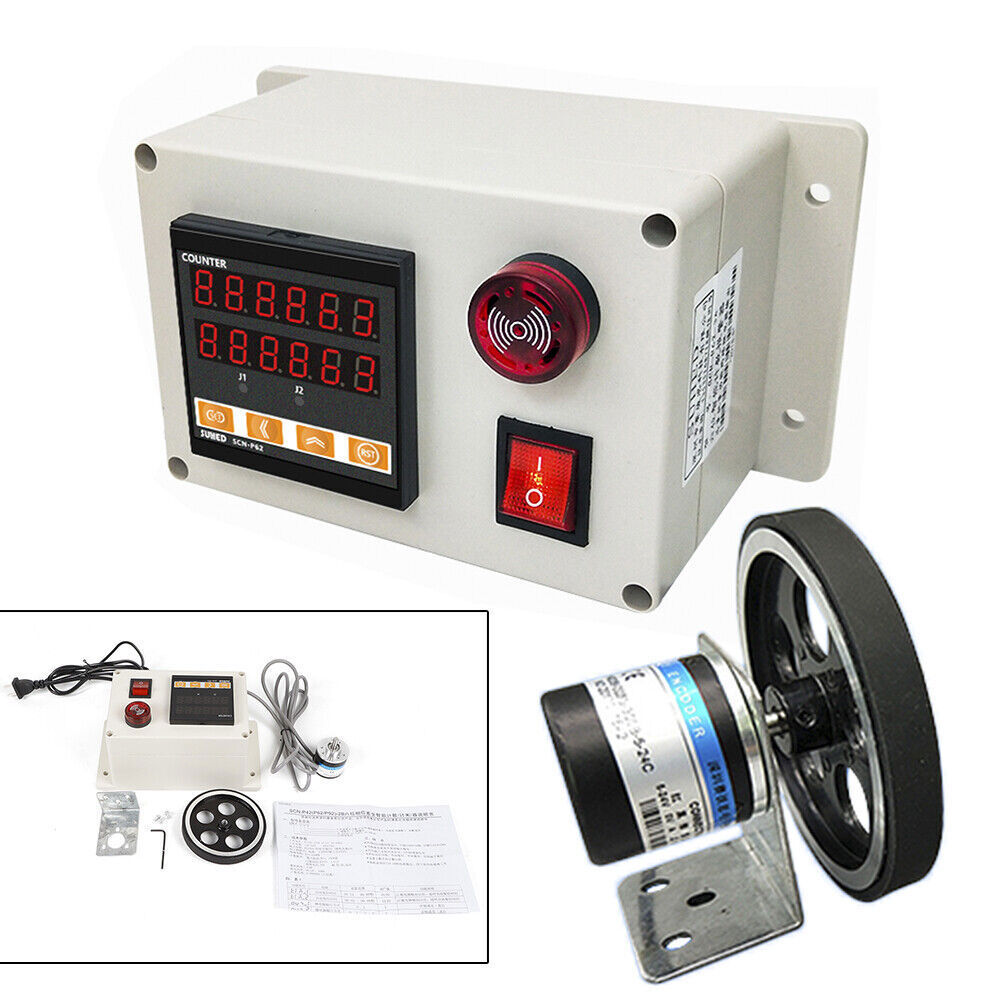

Photos from current listings. Actual item, color, and included accessories may vary.
Meter Counter Buying Guide
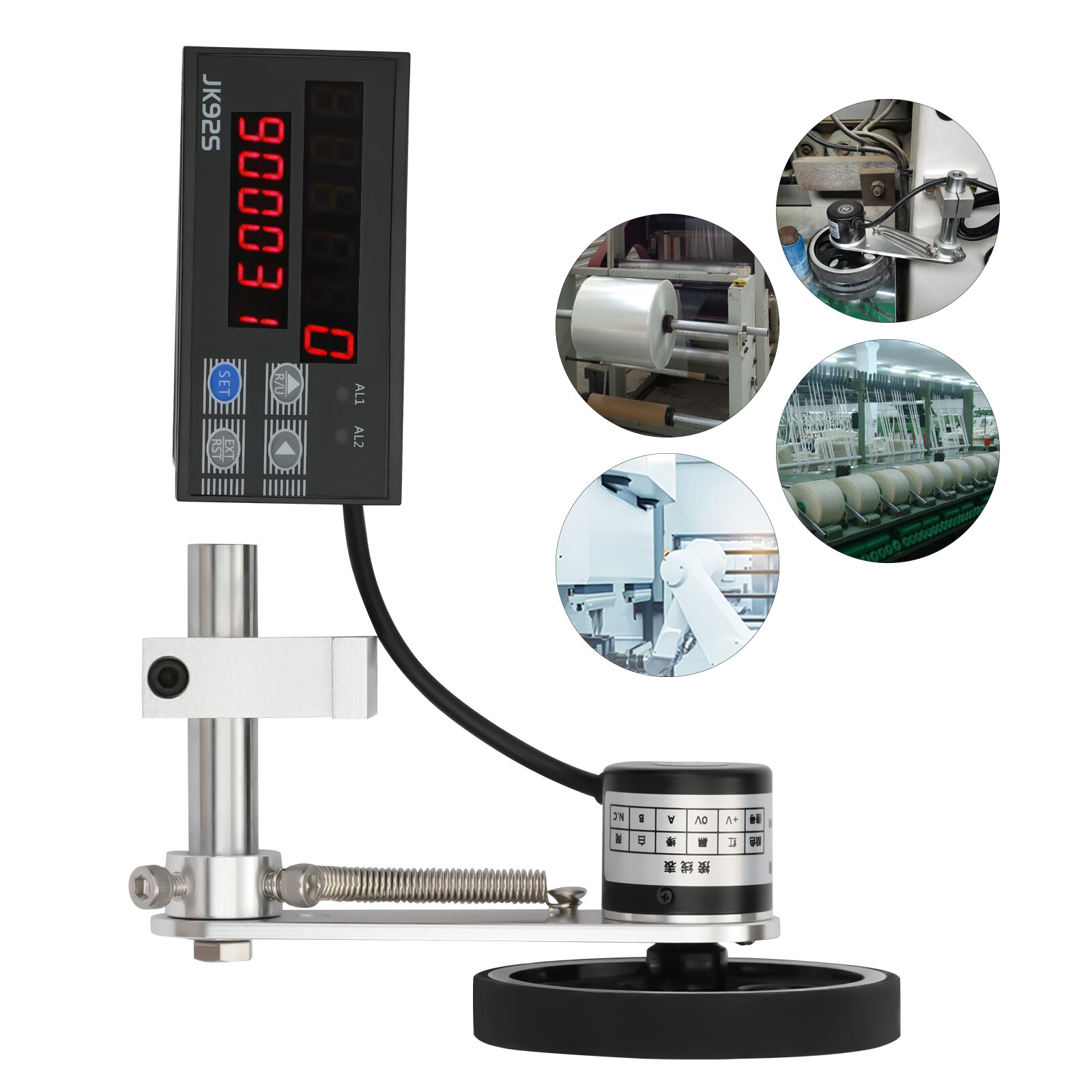
A meter counter is an industrial length-measurement device that pairs a rotary encoder with a digital display to tally linear distance from a moving wheel or cable. The core trade-off is encoder resolution and mechanical coupling quality versus display/control convenience: 300 PPR incremental encoders with proper quadrature counting outperform low-cost magnetic or single-channel units for accuracy. Choose a mechanically bracketed encoder wheel kit for permanent machine mounting; choose a handheld rolling counter only for intermittent spot checks.
Median $90.46
Key takeaways
- Encoder resolution of 300 PPR (pulses per revolution) yields ~0.1 mm per pulse on a 100 mm circumference wheel—higher PPR directly improves length accuracy at low speeds.
- Quadrature (A/B) incremental encoders detect direction and reject vibration-induced false counts; single-channel units drift and lose counts on reversing or vibrating lines.
- Wheel circumference defines scaling: a 200 mm wheel gives 1 pulse ≈ 0.67 mm at 300 PPR; a 300 mm wheel gives 1 pulse ≈ 1.0 mm—match wheel size to the smallest length increment you must resolve.
At a glance
- Category
- Industrial Gauges & Meters
- Last updated
- Nov 28, 2026
Current offers
Highlights
- Encoder resolution of 300 PPR (pulses per revolution) yields ~0.1 mm per pulse on a 100 mm circumference wheel—higher PPR directly improves length accuracy at low speeds.
- Quadrature (A/B) incremental encoders detect direction and reject vibration-induced false counts; single-channel units drift and lose counts on reversing or vibrating lines.
- Wheel circumference defines scaling: a 200 mm wheel gives 1 pulse ≈ 0.67 mm at 300 PPR; a 300 mm wheel gives 1 pulse ≈ 1.0 mm—match wheel size to the smallest length increment you must resolve.
- 110V/220V AC-powered displays suit fixed control cabinets; 12–24V DC or battery units suit mobile or field rolling-counter use—mismatched voltage is the leading install failure.
Best use cases
- Best fit: wire, cable, hose, or ribbon measured in continuous production—pick a bracketed 300 PPR encoder wheel kit with quadrature counter and 110V/220V cabinet display.
- Best fit: fabric, carpet, or paper roll measuring at a cutting table—choose a rolling wheel counter with a large-diameter wheel and preset/batch counting for repeat cut lengths.
- Wrong fit: measuring rigid straight stock or short (<1 m) lengths—a tape measure or caliper is faster; encoder wheels need sustained contact and movement to count reliably.
- Wrong fit: dusty or wet outdoor cable runs—standard open encoder wheels slip and contaminate; specify an IP-rated sealed encoder and wheel or use a contact-free laser length gauge.
Buying tips
- Size the wheel to your tolerance: for ±1 mm accuracy on a 300 PPR encoder, use a wheel circumference ≥300 mm so each pulse stays under 1 mm.
- Confirm encoder output type before buying: incremental quadrature (A/B) or push-pull HTL/TTL matches most industrial counters; absolute or SSI encoders need a compatible controller.
- Match counter input frequency to line speed: at 100 m/min with 300 PPR and a 200 mm wheel, pulse rate ≈2.5 kHz—verify the counter's max input frequency exceeds this with margin.
- For reversing or bi-directional lines, specify a quadrature counter with up/down counting; a single-channel totalizer will overcount on backfeed or vibration.
Specs
| Encoder Resolution | 300 PPR incremental (typical) |
|---|---|
| Encoder Output | Quadrature A/B (TTL/HTL) |
| Wheel Circumference | 200–300 mm contact wheel |
| Display Supply | 110/220V AC or 12–24V DC |
Related searches
What to check before buying
- Measure the mounting surface and shaft: encoder bracket bolt pattern and shaft diameter must match your machine frame or existing wheel hub.
- Verify supply voltage and plug standard: 110V AC (US NEMA 5-15), 220V AC (EU/UK), or 12–24V DC—confirm the counter and any sensor share the same supply.
- Check wheel contact: the wheel must ride the material with consistent pressure; confirm material width, tension, and surface (smooth vs textured) suit a contact wheel.
- Confirm display readability and reset: preset/batch functions, unit switch (metric/US), and remote reset are needed if the counter mounts inside an enclosure.
FAQ
Data sources: eBay / Amazon listings and product attribute feeds. Updated Nov 28, 2026.
Some links on this page are affiliate links. If you buy after clicking one, we may earn a commission at no extra cost to you. This does not change which products appear here or their order. Affiliate disclosure.